

Securitizing Borders and Local Conflict Dynamics – Insights from Benin
In 2025, Benin was among the West African coastal countries most affected by extremist violence spreading from Mali, Burkina Faso and Niger. An attack on 17 April which killed 54 soldiers was only one of many such incidents. In past years, the Benin government has significantly increased its military presence in Northern regions and has set up various national initiatives to securitize its borders with Burkina Faso, Niger, and Nigeria. While containing violence geographically might be necessary in the short-term, this focus overlooks the structural fault lines and root causes of conflicts that allow extremist actors to settle in and expand their influence, operating from relatively safe territory established in parts of Burkina Faso and Niger. This blog article shows how the security focus on stopping the ‘spillover’ of violence creates new grievances and vulnerabilities among the local populations living in affected areas. This provides fertile ground for extremist groups who exploit such grievances to implant themselves and – silently – mobilise support across communities.
Securitizing Borders to Stop ‘Spillover’
Coastal countries in West Africa – notably Benin, Togo, Ghana and Côte d’Ivoire – have seen an increase in violent attacks since 2021. While there are many ‘coastal’ countries in the region (ranging from Senegal to Liberia and Nigeria), current policy debate usually refers to West Africa’s ‘coastal countries’ as Benin, Côte d’Ivoire, Ghana and Togo. All share their northern borders with Mali, Burkina Faso, and Niger, which represent the region’s epicentre of violence linked to militant jihadist groups. Framing these states as ‘coastal’ has reinforced a dominant interpretation of increasing violence as ‘spillover’ from the central Sahel. Consequently, stopping the so-called ‘spillover’ of extremist insurgencies from the central Sahel is at the heart of interventions securitizing northern border regions of coastal West African states.
This dominant perspective has influenced security responses that prioritise border control and military containment. However, border regions are not simply security buffers. In northern Benin, as in other frontier areas, livelihoods depend on longstanding transborder mobility, trade, and negotiated access to resources as several studies – including those of Benin’s border agency (ABéGIEF) – have pointed out. In such contexts, heightened border controls can disrupt everyday economic practices and social relations. Based on field research carried out for a comprehensive study focusing on conflict dynamics in northern Benin’s border with Niger and Nigeria, this article shows the unintended local effects of border securitization policies aimed at preventing spillover, the grievances they create among the local population, and how armed actors are able to exploit these through localised and low-profile practices, gradually embedding themselves within communities and mobilising support.
Disruption of Local Livelihood Practices and Humiliation
Since 2022, the government of Benin has enforced its border securitization through an increased military presence – aimed at stopping the growth of jihadi groups, such as we saw with the recent Operation Mirador – and through combatting illicit trade. While these measures are both aimed at increasing control and containing cross border movement and purport to target different actors, both have serious consequences for local communities. As interviews have shown, the local impact of the government’s border securitization was particularly severe for young men whose livelihoods depend on trading, transport and transborder mobility – with the latter being a pattern of legitimate work and social responsibility within communities living in these borderlands. In border towns, the circulation of goods, access to markets, and fuel transport have historically constituted central livelihood practices through which young men secure income, autonomy, and social standing. These locally rooted meanings of mobility and transboundary movements have been disrupted by government policies.
On the ground, strengthening border security is experienced less as counterterrorism policy than as a steady interruption of everyday life. In the border municipality of Malanville, the intermittent closure of the bridge with Niger and stricter checks have unsettled long-established supply routes for grain, fish, and fuel, pushing traders onto longer and more expensive alternatives, with losses that are difficult to absorb. In Alibori and Atacora departments, curfews and closer monitoring of secondary roads have curtailed night travel, a key part of how weekly markets function and how perishable goods reach buyers on time. Around the W-Pendjari park area, restricted access to border zones has cut off households from informal activities that once supplemented incomes, without any immediate replacement. For pastoralists, the disruption of transhumance corridors has forced herds onto narrower fallback routes, increasing pressure on water and grazing land and reopening tensions with farming communities.
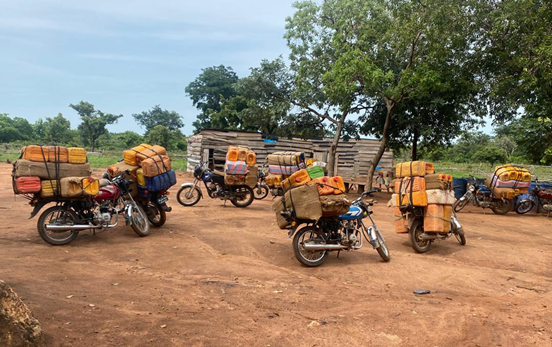
The expansion of roadblocks, inspections, and seizures along market routes has severely intensified routine encounters with police, customs, and military personnel – encounters widely experienced as degrading and demoralising. Operations directed at stopping informal petrol trade have proved particularly consequential and have produced a strong sense of injustice. As one young seller from Malanville stated in an interview conducted in March 2025, “I have already lost everything twice this year; the last time, they spilled all my fuel and insulted me in front of everyone. You feel humiliated, abandoned.”
Yet interviews with affected farmers and traders made it clear that they do not simply oppose the presence of security forces nor the regulation of border movements per se. Instead, they expressed very specific expectations and ideas about how border regulations can be meaningfully implemented. Within the context of this research project, residents called for control measures that can differentiate livelihood activities from illicit trafficking and acknowledge the importance of cross-border mobility, and which implement on dialogue with local actors rather than blanket restrictions imposed ‘from above’. What is clear is that the Benin government’s ongoing strategy to enhance local security through regulatory and military measures is putting local livelihoods under severe stress. They undermine economic routines and create repeated, humiliating encounters, thereby eroding trust in state institutions and subtly, yet permanently, reshape the local political landscape in northern border regions.
Gradual Reconfiguration of Local Power Relations
In 2025, field research on the Benin-Niger-Nigeria borderlands conducted on behalf of PATRIP Foundation showed how border securitization and the expansion of military intervention through Operation Mirador in northern Benin have transformed longstanding economic practices and patterns of mobility. The research also revealed how such efforts contribute to a severe reconfiguration of local political authority. Security interventions, including patrols, arrests, and controls carried out with limited consultation have weakened the position of the traditional and religious leaders that have historically mediated relations between communities and the state. These actors have long played a central role in conflict prevention, dispute resolution, and the regulation of everyday tensions related to land use, trade, and mobility. While they continue to command moral and social legitimacy, their capacity to act has been constrained by security practices that bypass them and reduce their scope for negotiation.
One village chief interviewed in March 2025 remarked, “… Before, security matters passed through us… When patrols or arrests were planned, we were informed and could explain the situation to families and calm tensions. Now interventions happen without warning, and we are asked afterward to restore order without having been consulted.” As everyday forms of mediation weaken, communities face increasing difficulty in managing insecurity internally, thereby creating space for alternative actors to intervene. This erosion of locally embedded authority has coincided with the accumulation of new grievances linked to border closures, economic restrictions, and coercive enforcement practices as described above. When these measures disrupt livelihoods or undermine the dignity of traditional and/or religious leaders, they (further) weaken confidence in state institutions, foster uncertainty, and produce fragmented patterns of regulation and protection for communities.
A significant consequence of these effects are the resulting gaps in capacity for localised conflict resolution, gaps that can be exploited by extremist actors to gain ground in communities. Similar to dynamics in Mali, Burkina Faso, and Niger, the presence of extremist groups initially develops through gradual involvement in everyday life along routes to fields, weekly markets, and health centres, e.g. by providing ‘security’ to local populations as an alternative to state actors. Individuals circulate, observe, and gather information on patterns of movement, local disputes, and vulnerabilities. Through repeated interaction, they come to be perceived as familiar figures embedded in local routines rather than as external intruders. Over time, this presence acquires substance through concrete interventions that address immediate and locally salient security concerns, including escorting traders along routes perceived as unsafe, mediating disputes between farmers and herders, recovering stolen livestock, or issuing warnings about impending threats. These practices draw on detailed local knowledge and respond to needs that state forces are often perceived as unable to address consistently. As a trader noted, “… They know the problems here and they know the routes. When something happens, they intervene immediately. With the authorities, you never know when they will come or what they will do…”
Understanding Local Trajectories of Extremist Violence
As outlined above, armed groups convert everyday practices of protection into a political resource, thereby reshaping local expectations of security and local authority. Comparable patterns have been observed across Sahelian borderlands, where informal and hybrid security arrangements emerge in response to fragmented or intermittent state authority and gradually acquire local authority through repetition, predictability, and relational proximity. Considering these dynamics is crucial for any type of intervention fostering violence in northern Benin’s borderlands. The attacks that occurred in Kalalé on 10 September 2025, targeting the police station and the communal health centre, must be understood within this longer trajectory.
From a local perspective, this was not perceived as an ‘external’ shock – i.e. following the dominant idea of a ‘spillover’ – but as a tipping point in an already unfolding process. Armed groups had already consolidated their position not through coercion alone, but through inserting themselves into a landscape that securitization, economic disruption, and weakened public regulation had shaped long before the attack. By occupying the gaps produced by border control policies and militarised governance, they establish a local presence. For many residents, engagement with these actors reflects a necessary adaptation to changing conditions rather than ideological commitment.
In the context of Benin’s recent legislative elections, heightened regional instability, and recent coup attempts, a securitized approach to stop the spread and increase of violence may seem reasonable from the perspective of its national government. Yet, while approaches fostering border regulation and security may succeed in displacing violence geographically in the short term, they often do so at the cost of further undermining already weak trust in state institutions, disrupting fragile transboundary economies without offering alternative income options, and weakening locally embedded mechanisms of conflict mediation.
As one example of West Africa’s coastal states’ response to the spread of extremist violence, the case of Benin shows that preventing ‘spillover’ through military enforcement and securitizing borders alone only builds on short-term stabilisation aims. While it might be necessary to halt the expansion of violence, any efforts that are limited to these measures will ignore the local vulnerabilities described above, and are thus likely to fail in the long-term. While an increased military presence is needed, responding to violence in northern Benin requires re-embedding security governance within local dynamics and (inter-)dependencies of border communities on mobility and cross-border exchange. Security policies must therefore be designed not only as instruments of territorial defence, but as tools of inclusive governance that acknowledge people’s perspectives. In northern Benin this implies to consider the transboundary nature of local economies, social ties, and authority relations – and to avoid reproducing the vulnerabilities through which violent extremist actors embed themselves.
Series
Related Posts
Tags

Latest posts by Simone Schnabel (see all)
- Securitizing Borders and Local Conflict Dynamics – Insights from Benin - 18. March 2026
- Das Ende vom Lied? Der anstehende Abzug von MINUSMA und was das für die deutsche Zusammenarbeit bedeutet - 3. July 2023
- Cohérence politique pour la paix dans l’engagement allemand au Mali et au Niger ? Cinq recommandations d’action pour le gouvernement allemand - 8. September 2022

Kamal Donko