

Negotiations in the Ukraine War – Europe on the Menu
Since Russia began its war of aggression against Ukraine four years ago there has not only been continuous fighting but also negotiations. Yet Europe has remained diplomatically hesitant. With US President Donald Trump at the helm, the US slipped into the role of power mediator. At this decisive turning point, Europeans failed to develop a coherent diplomatic approach and were unable to generate the necessary economic and strategic bargaining power. As a result, they are now forced to stand beside the negotiating table and watch as their interests are devoured.
The Biden Era: Support for Ukraine and Diplomatic Containment of the War
Russia’s war of aggression in Ukraine has been raging for four years. Diplomatic efforts to limit the impact of the war or even its duration have been ongoing for just as long. Corresponding to these efforts is a widespread assumption that (direct) negotiations are unlikely to succeed and that the war must be decided on the battlefield.[1] Yet if we analyze the diplomatic processes of the past four years using concepts from negotiation research and reconstruct the interplay between conflict dynamics and negotiation efforts in the course of the war, such assumptions crumble away.[2]
Negotiations to end the war in the first months of the invasion were unsuccessful, and not without reason. The draft agreement discussed at the end of April 2022 contained drastic concessions for Ukraine and did not reflect its strength on the battlefield at the time. After the negotiations broke down, and with the support of the West, Kyiv was able to retake large parts of its territory in the south and northeast, including the important cities of Kherson and Kharkiv. While diplomacy continued to play a role as the war progressed, it was mostly about mitigating its effects, rather than ending it. For example, the grain deal brokered by Turkey helped prevent a global food crisis.[3] Diplomatic initiatives also enabled the International Atomic Energy Agency (IEAE)[4] to monitor the Russian-occupied Zaporizhzhya nuclear power plant and facilitate repeated prisoner exchanges. Last but not least, negotiations also helped to contain Russian nuclear threats.[5]
The first three years of the war coincided with the presidency of Joe Biden. The Western alliance’s strategy essentially combined two approaches: on the one hand, gradually increasing support for Ukraine with weapons, money, and intelligence; on the other, careful escalation management to prevent the war from escalating horizontally (beyond the country’s borders) or vertically (through the use of weapons of mass destruction).[6]
Conflict Ripeness as a Window of Diplomatic Opportunity
Since the winter of 2022 the front lines have largely become deadlocked. The dynamics on the battlefield resemble those of a war of attrition, with both sides fighting not only against each other but against the constant shortage of equipment and soldiers. Russian losses in the spring of 2026 are estimated at 1.2 million dead and wounded soldiers, while much of its arsenal of weapons appears to have been depleted.[7] Ukraine mourns the loss of 500,000 to 600,000 soldiers (dead and wounded), the deaths of thousands of civilians, widespread destruction, and a humanitarian emergency due to Russian attacks on power, heating, and water infrastructure in dangerously cold winter temperatures. The war has also taken a heavy economic toll on the country.
Yet Russia’s ability to finance the fighting is also limited. Due to declining export revenues from fossil fuels, the National Wealth Fund has been largely depleted.[8] Consequently, Moscow has raised VAT and cut military spending in January 2026. However, rising oil prices during the Iran war, and the temporary lifting of US sanctions are significantly improving Russia’s revenue situation again [9]. At the same time, Putin lost important military partners during the war, including Syria, Venezuela, and Iran. There are growing indications that the war in Ukraine is reaching the stage of “conflict ripeness”[10], meaning that the costs of continued hostilities are no longer sustainable for either side, thus increasing the chances of a political solution.
The Trump Era: End of Partisanship and Mediation through Pressure and Incentives
Donald Trump’s inauguration on January 20, 2025, fundamentally changed the strategic context of the war in Ukraine. The new administration ended the US policy of partisan support for the attacked country, drastically reduced its material contribution, and pushed ahead with negotiations for a ceasefire and, in the long term, peace. With Trump, the US slipped into the role of power mediator,[11] using its resources to generate pressure and incentives to drive warring parties to the negotiating table.
US pressure was initially focused on Ukraine, with the administration even resorting to blackmail. After the debacle of President Zelenskyy’s visit to the Oval Office in February 2025,[12] Washington completely suspended its support for the besieged country for several days, until Zelenskyy shifted to the negotiation course pursued by Trump. Eventually the US also increased its pressure on Russia by tightening sanctions on Russian oil. Secondary sanctions on importing countries and penalties against the two largest Russian oil companies succeeded in reducing deliveries to China and India until the US and Israel attacked Iran in early 2026.[13]
Meanwhile, the White House enticed the Kremlin economically with the prospect of sanctions relief, reintegration into the global economy, and large-volume commodity agreements in the event of a peace agreement. Even more important for Putin, however, were Washington’s offers regarding future strategic relations – the exclusion of NATO membership for Ukraine, a resumption of strategic dialogue, and the reorganization of European security architecture.
Although less advantageous, Kyiv was also offered incentives. Economically, an exploitative but nevertheless profitable raw materials deal is on the table. In addition, the presence of US companies and investments would have a deterrent effect on Russia and thus provide Ukraine with moderate reassurance.
Anchorage as an Important Stopover
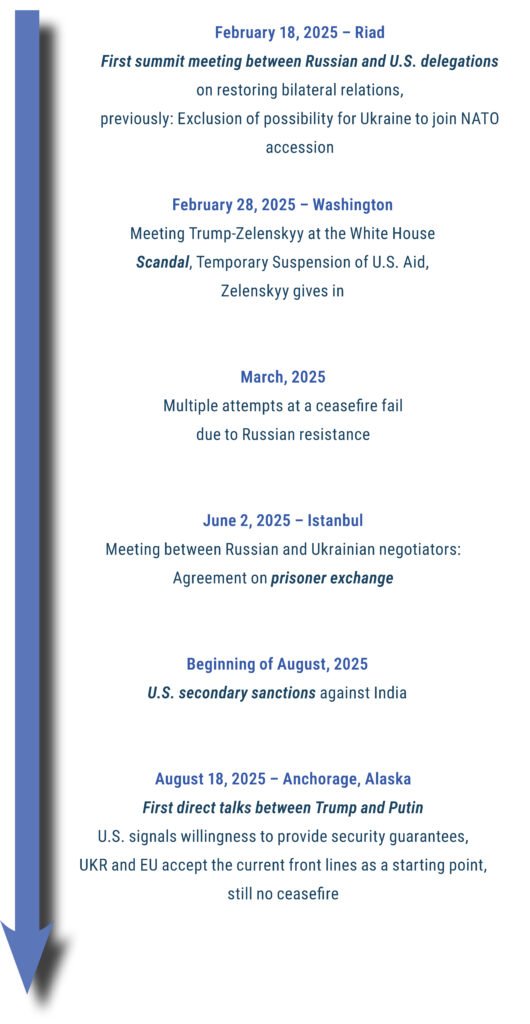
In August 2025, the American and Russian presidents met for direct negotiations for the first time since the invasion began. Previously, the Europeans had focused on strengthening Ukraine’s negotiating position and ensuring that the US took greater account of its interests. Washington’s willingness to provide further security guarantees at the bilateral summit can be interpreted as a success of these efforts. Moscow, for its part, tacitly approved this development. In return, Ukraine and the Europeans, who until then had not been officially inclined to make any territorial concessions, accepted the current front line as a starting point for resolving territorial issues.
However, the US, Ukraine, and the coalition of the willing were unable to prevail against Russia with their demand for an immediate ceasefire. Instead, the fighting intensified, including massive Russian attacks on civilian targets and infrastructure. Ukraine – forced to continue fighting – carried out successful attacks on strategic military targets and the Russian oil industry. Negotiations also remained at a high level, with both sides consistently using military and diplomatic leverage to defend their interests and war aims.
Outlining a Possible Agreement through Shuttle Diplomacy
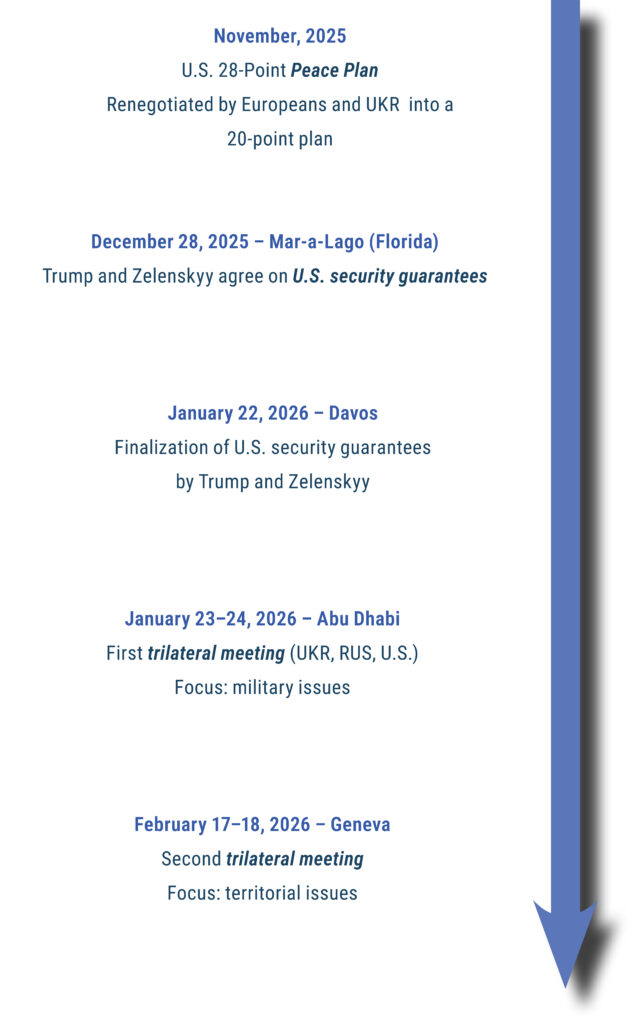
The US negotiating team led by Steve Witkoff and Jared Kushner continued to shuttle back and forth between Moscow, Kyiv, Washington, New York, Paris, and Berlin. In doing so, they always carried new, primarily economic and strategic bargaining chips with them. As an interim result of this shuttle diplomacy, the US 28-point peace plan[14] attracted public attention and criticism (it was considered too pro-Russian) in November 2025. Kyiv and its European partners formed their own negotiating front within the Western alliance and achieved substantial changes. Converted into a more balanced 20-point plan[15], it served as a further basis for negotiations.
An important breakthrough was achieved at Mar-a-Lago in December 2025 when the US and Ukraine agreed on military security guarantees to secure peace. In Davos, Trump and Zelensky finalized a deal that is believed to cover 15 years and includes a US-led monitoring mission.[16]
Finland, which shares a long border with Russia, opposed wording security guarantees too similarly to NATO’s Article V.[17] In the event of a resumption of fighting, Finland fears that the war could spread to its own territory. The extent to which Europeans will participate in security guarantees beyond arms deliveries and financing is still open. It also remains unclear whether French and British protection forces will be stationed on the ground.[18] Germany and other countries have indicated their willingness to provide assistance from neighboring countries in the event of an emergency.[19]
Europeans Remain Diplomatically Reserved and End Up at the Side Table
Beyond lobbying for Ukrainian positions on security guarantees and territorial issues, there is no record of any substantial diplomatic activity on the part of Europe. European governments have shied away from direct exchanges with Putin, finding it less risky (in domestic political terms) to react dismissively to the Trump administration’s negotiating activities[20] than to take the diplomatic initiative themselves and negotiate with the enemy. It was not until the end of 2025 that President Macron and Prime Minister Meloni advocated for a change in diplomatic course and direct talks with Moscow.[21] Chancellor Merz, on the other hand, rejected this as late as January 2026.[22] As a result, Europe was diplomatically marginalized and ended up without a seat at the negotiating table.
Yet Europeans have no less to offer economically and strategically than the US. They might have manipulated the Kremlin’s cost-benefit calculations in own their favor and to the advantage of Ukraine.[23] This could have included, for example, the prospect of restructuring the European security framework through a Europeanized NATO and a comprehensive OSCE reform geared toward national security interests. To negotiate a reduction in Russia’s sub-strategic nuclear capabilities, Germany could have signaled its preparedness to waive the stationing of strategically relevant American medium-range systems. The EU, in turn, could have flanked its sanctions policy with the perspective of a conditional revival of trade relations, similar to the US.
But Europe’s own opportunities to create incentives for an agreement were left untapped. The Europeans stuck to exerting pressure (sanctions against Russia and military support for Ukraine), drawing only on the tools they are weakest with. This strategic mistake is a historic failure, especially for German diplomacy, and one that may come at a high price for Europe.
Europe – the Strategic Loser
Following the first direct negotiations between Ukrainian, Russian, and American representatives in Abu Dhabi and Geneva, many issues appear to have been resolved. Potential parameters for ending the war in Ukraine and reaching a peace agreement are taking shape.
Provided that negotiations do not fail on the final (and critical) territorial issues, Russia will not leave the battlefield as the clear victor, judging by its initial war aims. Rather, Ukraine has asserted itself as a sovereign nation and strengthened its internal and external cohesion, despite suffering heavy territorial losses.
Regarding the strategic relation between Europe and the US, Putin appears to have already won. In the course of the war in Ukraine, Russia has been able to expand its nuclear escalation dominance on the continent, among other things through the development and demonstration of new hypersonic delivery systems and cruise missiles, as well as the deployment of Russian nuclear weapons in Belarus.[24] At the same time, Putin seized the opportunity to accelerate the US withdrawal from conventional defense in Europe. The US defense strategy adopted in January[25] explicitly commits to this goal, and the subsequent transfer of two American military command posts to European commanders in February[26] was also publicly announced during the trilateral negotiations.
Europe would thus emerge from the war as the strategic loser. Not because of Putin or Trump’s ruthlessness, but because it refused to stand up for its own interests against its opponent and defend them in negotiations. After all, those who are not seated at the table may end up on the menu.
Editor’s note: This Blog is based on PRIF Spotlight 05/2026, which was published in German on March 17, 2026.
Series
Related Posts
Tags

Sascha Hach
Latest posts by Sascha Hach (see all)
- Negotiations in the Ukraine War – Europe on the Menu - 20. March 2026
- Verhandlungen im Ukrainekrieg: Europa auf der Speisekarte - 17. March 2026
- What the West Got Wrong About Russian “Hybrid Warfare”: Understanding Russian Unconventional Activities Will Determine Future Strategies and the Resilience of Europe - 3. February 2026