Who Can Keep Taiwan at Peace? – Security Politics in the 2026 Local Elections and the Road to 2028
Taiwan has the potential to become the world’s most consequential geopolitical flashpoint. Its major parties agree on peace and democratic self-government but differ sharply over questions of engagement with China and the strengthening of self-defence, feeding a protracted executive–legislative deadlock. Taiwanese local elections on 28 November 2026 will not bring an end to Taiwan’s divided government, but the outcome is likely to force the opposition to recalibrate its strategy. The first test comes with key defence budgets in early 2027, and its outcome will shape major parties’ security platforms for the 2028 national elections.
The Democratic Progressive Party (DPP), which emphasises Taiwanese identity and “peace through strength”, has won three straight presidential elections since 2016. But in 2024 the party lost its legislative majority despite its candidate, Lai Ching-te, winning the presidency. The Kuomintang (KMT), the main opposition party, which stresses a Chinese cultural-national identity and engagement with China, controls the legislature together with the Taiwan People’s Party (TPP). Defence funding has since become one of the sharpest disputes of the resulting divided government. The government seeks to bolster air and missile defence, buy precision-strike and anti-armour weapons, mostly from the United States, and expand domestic production of drones and unmanned surface vessels. Citing insufficient detail and risk of waste, the opposition has cut funding and delayed approvals.
The KMT’s handling of defence budgets, along with other contested bills, has frustrated voters well beyond the swing electorate and drawn pushback from its own candidates. As the campaign for the 28 November local elections turns against the party, rifts over its security line are deepening. The party centre under chair Cheng Li-wun prioritises engagement with China and tight scrutiny of defence spending, while locally rooted politicians facing voters lean towards closer US ties and visible support for Taiwan’s own defences.
The 2026 elections leave national offices untouched, but likely losses would push the KMT to recalibrate its security line and legislative conduct, most immediately on the critical 2027 defence budgets. Without such a shift, the KMT is unlikely to win the trust of most voters in the 2028 presidential and legislative elections.
Peace Is the Consensus, Partisan Division over the Means
Taiwan’s major parties, the DPP and KMT, share a commitment to peace and democratic self-government. Neither can afford otherwise. Since 1994, National Chengchi University’s Election Study Center has found stable majorities favouring some form of the status quo: nearly nine in ten in its latest survey, with eventual independence preferred to eventual unification (21.7 versus 6.3 per cent) and few wanting either soon.1 Opposition to unification is the mainstream view but need not imply appetite for confrontation; many favour dialogue but refuse to accept China’s objectives or political preconditions. Both parties respond to this public mood but disagree on where the risk lies and how to counter it.
The DPP locates risk in China’s increasingly coercive pressure and argues that Taiwan must centre on deterrence, with stronger self-defence, closer cooperation with the United States, Japan and other like-minded democracies, and greater societal resilience. It has also sought to reduce economic reliance on China, with some success. China and Hong Kong took 26.6 per cent of Taiwan’s exports in 2025, down from 43.9 per cent in 2020, and mainland China’s share of Taiwan’s approved outward investment fell from 83.8 per cent in 2010 to 3.8 per cent in 2025, while the United States, driven by the AI boom, has become Taiwan’s largest export market.2 The DPP does not reject cross-Strait dialogue, but insists that democracy and freedom cannot be bargaining chips and that dialogue must rest on credible self-defence.3
For the KMT, sufficient defence and stable US relations remain necessary, but its approach is fundamentally pro-engagement. It argues that the DPP’s pro-independence positioning has blocked cross-Strait dialogue, provoked Beijing, and fuelled tensions. In its view, communication reduces misperception while economic ties create incentives for restraint, making engagement the central instrument against escalation. The KMT’s advantage, on its own reading, is a party-to-party channel with the Chinese Communist Party (CCP), something the governing party lacks.
The KMT’s traditional formula of close relations with the United States, friendship with Japan, and peace with mainland China seeks to reassure all three.4 But as China’s rivalry with the US and Japan intensifies, measures that may reassure Washington and Tokyo, such as higher defence spending, are read by Beijing as hostile. Meanwhile language that eases contact with the CCP deepens doubts at home and abroad. The once-balanced middle ground has become a dilemma over which relationship to prioritise.
Engagement also creates an asymmetric credibility problem. China decides which Taiwanese actors receive access and on what terms, and can present KMT-led exchanges as evidence of eventual unification, while the KMT cannot guarantee reciprocal restraint. Even the economic ties the KMT presents as a dividend of engagement can be withdrawn at will. Since 2021, Beijing has repeatedly banned imports of Taiwanese fruit and fish, citing pests or food safety, with timing widely seen as political. When coercion continues alongside party-to-party contact, the KMT must either criticise the CCP and risk its channel, or downplay the pressure and reinforce suspicions that access has come at the expense of Taiwan’s security. The more it presents access to China as a distinctive asset, the more it must show that access produces restraint rather than dependence.
The KMT’s Unsettled Security Line
The KMT has never settled on a stable way to reconcile two audiences: ideologically committed members who dominate internal elections and favour prioritising engagement, and a broader electorate that consistently views China with suspicion. KMT politicians have instead improvised based on immediate needs, shifting emphasis between engagement and defence on the one hand and access to Beijing and credibility with Washington on the other. The result is a broad spectrum of overlapping positions.
At one end sits the party centre under Cheng, anchoring the KMT near the engagement pole and sustaining legislative confrontation with the DPP, resonating with activist members who wield disproportionate influence in internal contests. At the other end are figures who depend on swing voters and confidence in Washington and have strong incentives to keep their distance from the party centre, most prominently the mayor of Taichung, Lu Shiow-yen, a leading contender for the 2028 nomination. Because most KMT politicians hold fluid positions somewhere in between, disagreements concern tactics as much as ideology: which audience to reassure first and which costs to absorb.
This year’s dispute over the Cabinet’s NT$1.25 trillion special defence budget illustrates the spectrum. The KMT’s party centre backed only NT$380 billion, while Lu, back from talks in Washington, called NT$800 billion to NT$1 trillion reasonable. KMT legislators gravitated towards one figure or the other depending on whether they represented safe or swing districts. The budget eventually passed with a NT$780 billion ceiling, essentially a compromise among the party’s competing positions.
How the KMT Will Shape Taiwan’s Security: From the Local Vote to 2028
The KMT’s divisions over security and legislative strategy have shaped the campaign. The results, in turn, will redistribute influence over its security line. Whatever the real causes, the party centre will be held responsible for any losses.
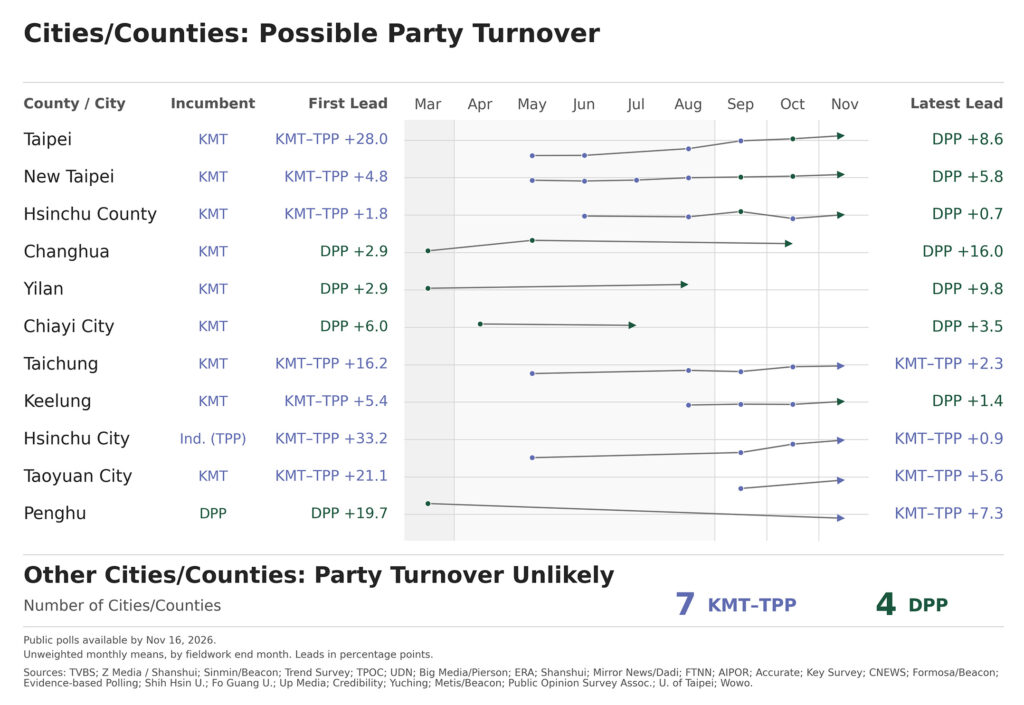
The KMT began the local elections with grounds for confidence: counting the KMT, TPP and allied independents together, the blue-white camp holds 17 cities and counties, the DPP five. Polling to 18 November, however, points to a 13–9 or 12–10 split in the blue-white camp’s favour. The DPP is likely to lose one of its five, but to take four elsewhere and possibly one of Taipei and New Taipei, or even both. Four more KMT-held cities once thought safe are also now in play; the DPP only needs to win two to flip the result to 10–12.
Whatever the aggregate vote, winning Taipei, the traditionally KMT-leaning capital, or New Taipei, the most populous city and KMT-governed since 2005, would be read as a major DPP victory. In both cities, the KMT’s erosion owes much to its candidates’ controversies and their opponents’ unexpectedly strong appeal. Yet internal critics say the party centre alienated swing voters and even some soft KMT supporters, or at least proved too unpopular and poorly coordinated to help candidates in tight races. Other setbacks are attributed directly to the party centre: nomination disputes that have turned KMT-governed Changhua into a certain loss and failed coordination with the TPP that has put Hsinchu County in jeopardy. Local figures have already demanded, in Cheng’s presence, that she accept responsibility for potential defeats. Weak results would let these organisational grievances merge with criticism of her security line, leaving her under intense pressure to resign or moderate her position.
The first test of any recalibration will come in the legislature. Executive–legislative conflict delayed the 2026 central budget until August, and the opposition placed domestic unmanned systems under a separate law requiring annual appropriations. In 2027, the KMT will face decisions on defence allocations in the central budget (put by the Cabinet at about 3 per cent of GDP), annual funding for unmanned systems, and appropriations for further US arms packages. A chastened KMT would have reason to pass these with fewer cuts and delays and repair Washington’s confidence. Continued confrontation would compound uncertainty over US deliveries and deepen partners’ doubts about Taiwan’s commitment to its own defence.
The results will also reorder the KMT’s 2028 presidential field. Even if Cheng survives as chair, she could no longer credibly count herself a contender. Taipei Mayor Chiang Wan-an, who traces his lineage to the family whose two presidents ruled Taiwan under martial law, was the party’s most popular politician this summer but now risks losing re-election. That leaves term-limited Taichung Mayor Lu as the likeliest nominee, but the DPP’s momentum has tightened the Taichung race too. A loss by her endorsed successor would dent her standing, potentially allowing Legislative Speaker Han Kuo-yu to emerge as a rival. Though he lost the 2020 presidential election, he has since recovered some standing. Credited with brokering the special defence budget compromise, he was warmly welcomed in Washington and, back home, publicly rebuked the KMT’s caucus leader for stalling the central budget.
With the campaign running in its favour, the DPP has little reason to change its security line, and President Lai will seek re-election. For the KMT, whoever its nominee, keeping its security line and legislative conduct would leave little chance of regaining the presidency – regardless of debates over whether a long stretch without alternation in power is healthy for democracy. The likely outcome would be continued divided government under a DPP president or unified DPP rule. Security, already a factor in local elections, will weigh more heavily nationally, when voters decide who they trust to keep Taiwan at peace.