


Who Gets to Mourn? Rethinking Grief, Resistance and the Everyday Politics of Peace in Colombia
What does it mean to resist when there are no slogans, no marches, no chants, only grief? This piece argues that the Women, Peace and Security agenda—despite its historic contributions—has often reduced women’s political agency to visibility, voice, and institutional participation. A feminist lens invites us to look beyond this framing and recognise the everyday, intimate, and affective forms of resistance through which women remember the dead, survive violence, and hold broken communities together.
Introduction: The Quiet Work of Peace
A handful of women gather at dawn on the broad grey‑stone steps of the Plaza de Bolívar, in Bogotá. Each carries a well‑worn boot — the heavy leather boot of a young man from their hometown, executed as part of a systematic pattern of extrajudicial killings later exposed as one of Colombia’s notorious “Falsos Positivos” (false positives). Some boots are painted bright red; others bear messages in chalk: “La memoria no se bota” (“Memory cannot be thrown away”). They are the mothers of the disappeared—women from Soacha—bringing their grief and demands to the heart of Colombia’s capital.
Between 2002 and 2008, Colombia witnessed one of the most harrowing episodes of its internal armed conflict: a systematic campaign of extrajudicial killings carried out by sections of the military. In what came to be known as the false positives, civilian men, often from rural or marginalised urban zones, were misled or lured with promises of work to remote areas, executed, and then presented by military units as deceased guerrilla combatants. The transitional justice tribunal Special Jurisdiction for Peace (Jurisdicción Especial para la Paz -JEP), has since documented at least 6,402 such cases nationally.
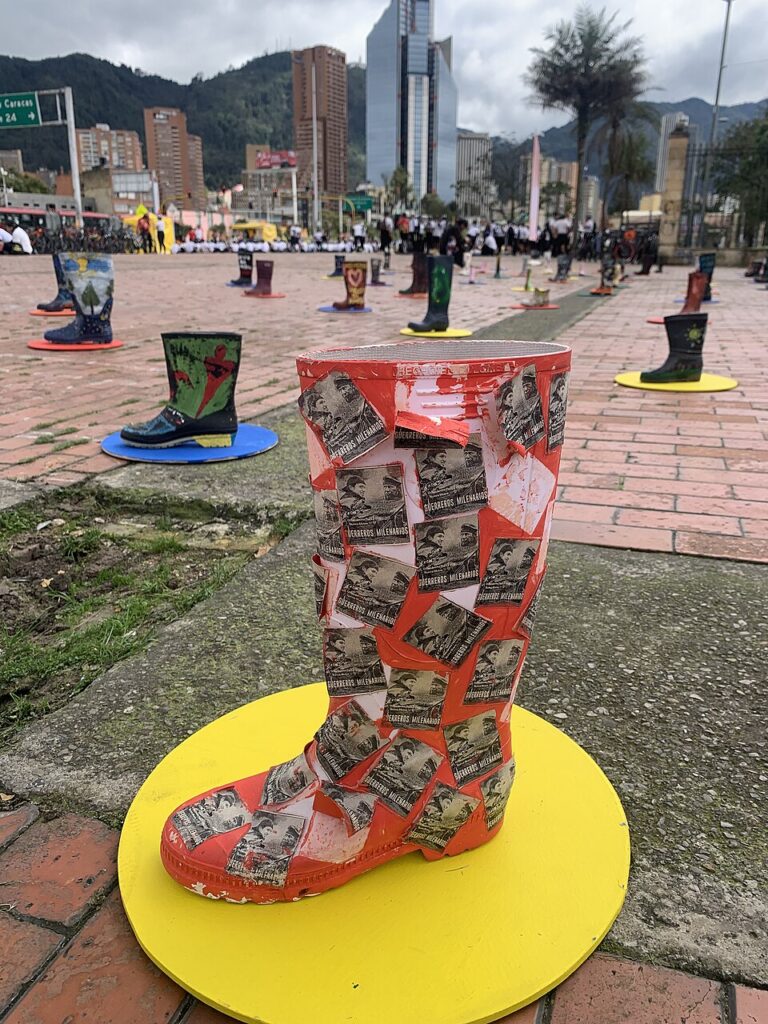
In moments like the quiet placing of a boot or the gathering of women between rural roots and urban protest, we see how grief becomes political. Their journey—from remote memorials to the heart of power—challenges the divide between margin and centre. These women carry their boots across that divide, saying: our grief belongs here, too.
What if grief, then, rather than participation in formal peace processes, is one of the most consequential yet less acknowledged forms of political work that women do in post-conflict societies?
By mourning in public, they transform silence into denunciation. In doing so, they invite us to reflect and rethink the Women, Peace and Security agenda, which too often centres inclusion at the negotiation table while overlooking the radical politics of those who mourn outside the gates.
Since its adoption in 2000, the Women, Peace and Security (WPS) agenda has made historic strides in recognising the gendered dimensions of war and in institutionalising commitments to women’s inclusion in peace processes. Yet, in its focus on visibility—women at the table, women as peacebuilders, women as rights-bearing subjects—the agenda has often privileged legibility over lived experience.
The Soacha mothers remind us that peace is not only made in conference rooms or courtrooms, but also in plazas, kitchens, and cemeteries. Their struggle invites us to expand the scope of WPS—to attend not only to women’s presence in formal processes, but to the everyday and emotionally charged terrains where peace is continually resisted, redefined, and reassembled from below.
Rethinking Resistance: Civilian Agency and Feminist Disruption
Much of what we know about civilian resistance comes from studies that focus on moments of public defiance: marches, boycotts, or community expulsions of armed groups.
In this blog, I want to invite the reader to consider a broader horizon of what civilian resistance can look like. Beyond marches or confrontations, resistance often takes quieter, slower, and more ambiguous forms. The refusal to legitimise state narratives, the choice to bury loved ones without waiting for official recognition, the act of remembering in ways that unsettle dominant histories.
Feminist thinkers have long asked us to shift our gaze. What if resistance isn’t always loud or confrontational? What if it begins in acts of care, memory, and quiet endurance? Such feminist interventions demand that we unsettle our own categories.
In the context of Colombia’s armed conflict, we must ask: Is a mother’s search for her disappeared son less political than a community’s protest against a paramilitary roadblock? What if the very act of remembering — of insisting that a son was not a guerrillero (guerrilla fighter), but a civilian — is a form of resistance?
Women have been resisting armed and state violence in quite ways since decades — the mothers of Soacha are only one of many examples.
Another powerful case is found in Bojayá, a remote, majority Afro-Colombian community in the department of Chocó, on Colombia’s Pacific coast. On May 2, 2002, over a hundred civilians were killed when a FARC-launched gas cylinder bomb exploded inside a church where residents had taken refuge during clashes with paramilitaries.
Afro‑descendant women of the Atrato basin laboured for years to recuperate the memory of what has been called a mala muerte (bad death), because the victims could not perform their own mortuary rites and their bodies were dispersed, unidentified, or delivered years later. In the ceremony, Bojayá honra a los sagrados espíritus (Bojayá honours the sacred spirits), held in 2019, the community offered 101 coffers, including unidentified remains, for a collective and symbolic vigil. After nearly two decades, the ritual allowed the community to perform a proper goodbye according to their traditions.
In urban‑adjacent contexts, similar dynamics of mourning‑as‑resistance appear, albeit in different social and spatial registers. In Medellín’s Comuna 13, for example, the women known as las cuchas (a local, affectionate term for mothers) led years-long efforts to have La Escombrera—a vast rubble site—recognised as a clandestine graveyard used by paramilitary groups and the military during the early 2000s. Their struggle has taken many forms: public memorials and murals like “Las cuchas tienen razón” (“The mothers are right”), performative actions in public spaces, pressure on media and institutions, and tireless efforts to search for the disappeared.
Rethinking the WPS Agenda: Beyond Visibility and Voice
Over the past twenty-five years, the Women, Peace and Security (WPS) agenda has made important gains, recognising the gendered nature of conflict and promoting women’s inclusion in negotiations, quotas, funding, and protection measures. Yet this institutional progress carries persistent blind spots: which women are included, under what terms, and at what cost to more intimate, collective, or subversive forms of political agency?
The WPS agenda still operates through a politics of visibility. “Women’s participation” often becomes a matter of counting seats at the table or highlighting leadership in forms legible to donors and institutions. While this has value, it also privileges women already close to power or able to speak in institutional terms. In turn, quieter forms of agency—mourning, care, memory work, refusal—are sidelined.
Consider the case of the Madres de la Escombrera in Medellín. These women spent decades searching for their forcibly disappeared relatives, suspected to be buried beneath a rubble dump. Yet this kind of grief-based activism rarely fits within the performance of agency expected by the WPS framework.
Similarly, in Bojayá, Afro-Colombian women turned mourning into a form of community repair. After the 2002 massacre, they spent years documenting oral histories, organising collective funerals, and developing rituals that blended ancestral spiritual practices with public political claims. Their memory work created a new moral landscape: one that refused to reduce their experience to a number in a report, and instead reclaimed the dead as sacred ancestors, as community members whose loss demanded public recognition.
Grief, as these Colombian cases reveal, is not a neutral or private emotion—it is a deeply political and gendered practice that can unsettle dominant narratives of post-conflict recovery. And yet, it remains vulnerable to co-optation, institutional instrumentalisation, or outright neglect. State transitional justice mechanisms may seek to “include” victims’ voices, but often do so on highly regulated terms. Pain is allowed, even invited, but only if it fits institutional scripts of reconciliation, or contributes to official statistics. In such spaces, mourning is not heard as resistance but framed as catharsis or closure.
What would peace look like if we recognised grief as political? To unlock the transformative potential of WPS, we must begin by challenging its epistemic assumptions: Who defines peace? What counts as participation? And who gets to decide what a feminist intervention looks like? Rather than expanding the existing agenda to “include” more women or more voices, we might instead ask how the entire frame could be reoriented—away from visibility and toward attentiveness; away from representation and toward relationality.
One possibility lies in shifting the register of WPS from reform to refusal. Drawing from the concept of negativity as hope (following scholar Valerie Waldow), we might see grief not as something to be processed or overcome, but as a productive political force—a force that resists closure, refuses reconciliation on unjust terms, and holds space for what remains unresolved.
This is not a call to abandon the WPS agenda, but to reimagine it from the margins. As Sandra Harding reminds us, the task is not to “add women and stir,” but to rethink what counts as knowledge. If mourning, care, and memory are understood as forms of knowing and resisting, then peace becomes more than the absence of war—it becomes the ongoing effort to name violence, confront it, and refuse its erasure.
What Peace Asks of Us
In Bogotá’s Plaza de Bolívar, the Madres de Soacha lined up boots for their sons—victims of the false positives. Their silence spoke louder than protest: grief as refusal, as resistance.
This image remains etched in Colombia’s post-conflict memory landscape—not because it was absorbed into policy or broadcasted widely, but because it refused to perform peace in the way institutions expect. The boots said: we are not moving on. We are still here. This act, like the mourning rituals of Bojayá and the unrelenting search of the Madres de la Escombrera, calls us to widen our lens. To rethink not only what counts as resistance, but what counts as peace.
The Women, Peace and Security agenda—despite its historic contributions—has often reduced women’s political agency to visibility, voice, and institutional participation. Yet a feminist lens reminds us that this framing overlooks the everyday, intimate, and affective labour through which many women resist violence, remember the dead, and sustain broken communities. In essay I have endeavoured to illustrate alternative modes of political agency. Whether in rural cemeteries or urban margins, whether through collective rituals or solitary care, women perform a kind of peace work that is both political and profoundly personal, yet too often invisible to the formal architectures of transitional justice, security governance, and international peacebuilding.
To imagine grief as political is to imagine a WPS agenda not limited to seats at the table, but open to the politics of tending graves, naming the disappeared, and holding vigil in silence. It is to say that peace cannot be declared solely by institutions—it must also be enacted in plazas, kitchens, riverbanks, and ruins.
For policy makers, this means listening differently, not only to what is said but to what is withheld, repeated, embodied. It means noticing the silences that resist translation, the gestures that do not fit our coding frameworks, the truths that are spoken not in words but in rituals, photos, and scars. For activists and institutions, it means honouring the labour of those who mourn without asking them to perform resilience. It means supporting memory not as closure but as continued struggle. For those of us invested in post-conflict futures, it means recognising that care is not the opposite of politics, but its foundation.
Perhaps the most radical act in a post-conflict society is not to forgive, or to forget, but to grieve openly. To build memory when no one is watching. To insist on the value of every life, even when the state has tried to erase it. These are not small acts. They are the beginnings of another kind of peace—slower, deeper, and more just.
Reihen
Ähnliche Beiträge
Schlagwörter
Laura Marcela Zúñiga