

Fading Memories of Hope and Empowerment? Why Remembrance of the Peaceful Revolution in Germany Matters and Needs to be Strengthened
Thirty-six years after the so-called Peaceful Revolution of 1989, the foundation stone for the Monument to Freedom and Unity was laid in Leipzig—a milestone in German commemorative culture. But as memories of the events fade, the once unifying narrative of the Peaceful Revolution as a success story is slowly beginning to crumble. Using survey data, this article examines knowledge and interpretation of the Peaceful Revolution in Germany and shows how this influences political participation and what can be done to preserve the legacy of the German civil rights movement.
On October 9, 2025, 36 years after more than 70,000 people gathered in Leipzig for the Monday demonstration in 1989, the foundation stone for the Monument to Freedom and Unity was laid on Wilhelm-Leuschner-Platz. The peaceful protests in Leipzig were to become a key moment in the so-called Peaceful Revolution. Under the slogan “We are the people”, the protests would spread until November, when they drew nearly 1 million people in Berlin. The event would ultimately mark the end of the German Democratic Republic and the paving of the way for German reunification. Like the central Freedom and Unity Monument currently under construction in Berlin, the monument in Leipzig is intended to “preserve the values and experiences of the Peaceful Revolution” and “inspire current and future generations.” Because the so-called second German dictatorship and the positive memories of the peaceful revolution remain persistently underexposed, the laying of the foundation stone in Leipzig represents an important milestone for German remembrance policy. However, the laying of the foundation stone comes at a time when Germany is experiencing increasing political polarization, the success of populist parties, and growing dissatisfaction among citizens with democratic institutions, especially in eastern Germany. Against this backdrop, this Spotlight presents the results of a new representative survey on knowledge and interpretation of the Peaceful Revolution in Germany (this research was funded by the Diligentia Foundation). Based on these results, we discuss the broader implications of our findings for democratic participation and the culture of remembrance in Germany. In other words, what can be done to preserve the legacy of the German civil rights movement?
People Power Movements, Collective Memory and Democracy
Research in the field of memory studies emphasizes the importance of collective memory – a group memory that transcends individual memory and is closely linked to the identity of that group. Shared collective memory and identity are particularly important for large groups, such as nations, which may lack a prior sense of community or the connections of a shared history. Indeed, these are sometimes invented in the course of state and nation building. Historical examples include Italy and Germany, which consisted of a multitude of small states before unification. The politics of the past, i.e. the active remembering of certain events – or indeed their active repression and forgetting – becomes an important building block for the development of this collective identity.
Studies on protest and nonviolent resistance have shown that peaceful protests leading to a transition towards democracy, like those in the GDR in 1989, can have a lasting effect on that democracy’s quality and stability. Peaceful protest and resistance movements are seen as the nucleus of a democratic civil society which, driven by values such as freedom and participation, ensuring that the new political structures facilitate these for everyone. Further, such events provide a powerful symbol for the sovereignty of the people which can boost feelings of political efficacy and serve as “history lesson” for future generations. Against this background, it is not surprising that such historical experiences are kept alive through monuments, via school education and political speeches. On the occasion of the 30th anniversary of German reunification, Federal President Steinmeier described the events of October 9, 1989, as follows:
“The Wall did not just fall. It was brought down by the people of the GDR – peacefully and without violence. […] We can draw strength from the memory of how people stood together for a better life in a better country […] Let us take something of this with us into our shared future […] This is also a legacy of 1989 that binds us all: a living democracy needs the courageous, the confident, the proactive.“
As outlined, the monuments in Leipzig and Berlin follow this same idea: To remember and to inspire future generations. However, the narrative of the peaceful revolution has always had to compete with other narratives, such as the “Wende,” a change brought about by political elites such as Helmut Kohl, Reagan, and Gorbachev, and the recent attempts by the Alternative for Germany (AfD) party to redefine it as “unfinished” and exploit it politically. From 2019 onwards, and particularly during the 2021 federal elections and the 2024 state elections, the AfD rhetorically linked itself to the Peaceful Revolution with the slogan “We are the people” (Wir sind das Volk). With the slogan “Complete the Change” (Vollende die Wende), they attempted to mobilize voters by reinterpreting it as an unfinished task. This, in turn, led to resistance from 172 civil rights activists who opposed this appropriation of the Peaceful Revolution.
Today, questions remain: how widespread is the narrative of Germany’s successful peaceful revolution? How can we preserve this memory, especially in times of polarization? In the next section, we present some empirical findings on the first question from the project Echoes of the Past.
When Memories Fade, the Space for Reinterpretation Grows
To provide a current assessment of the culture of remembrance about the Peaceful Revolution, we report findings from a representative online survey conducted in October 2025. Our focus is on analyses of respondents’ knowledge about the Peaceful Revolution and their interpretation of it as a success story (see box 1 for details).
To probe the knowledge of respondents, we included quiz questions in our survey that asked about the time, place of origin and main slogan of the Peaceful revolution. In total 85% of the respondents knew the correct year of the revolution (1989), 61% gave the correct place of origin (Leipzig), and 75% named the correct original slogan of the revolution (We are the people). However, fewer than half of respondents (~47%) were able to answer all three basic knowledge questions correctly. Figure 1 displays the share of respondents that answered all three basic knowledge questions correctly across age groups.

As shown in figure 1, there appears to be an age-related pattern in knowledge about the Peaceful Revolution. Among younger respondents in age groups 18–29 and 30–39, only about 36% answered all three basic knowledge questions correctly. This share increases substantially among older age groups to around 50%. This pattern indicates differences in educational exposure and experience across generations. While the older cohorts experienced the Peaceful Revolution themselves in their youth or adulthood, the younger cohorts only know about it from second-hand sources, such as television reports, school lessons, conversations within the family, or with contemporary witnesses. Since the latter two sources were cited by around 28 percent as the source of their knowledge, we can assume that, as these wellsprings of knowledge dry up, knowledge about the Peaceful Revolution will also continue to diminish over time.
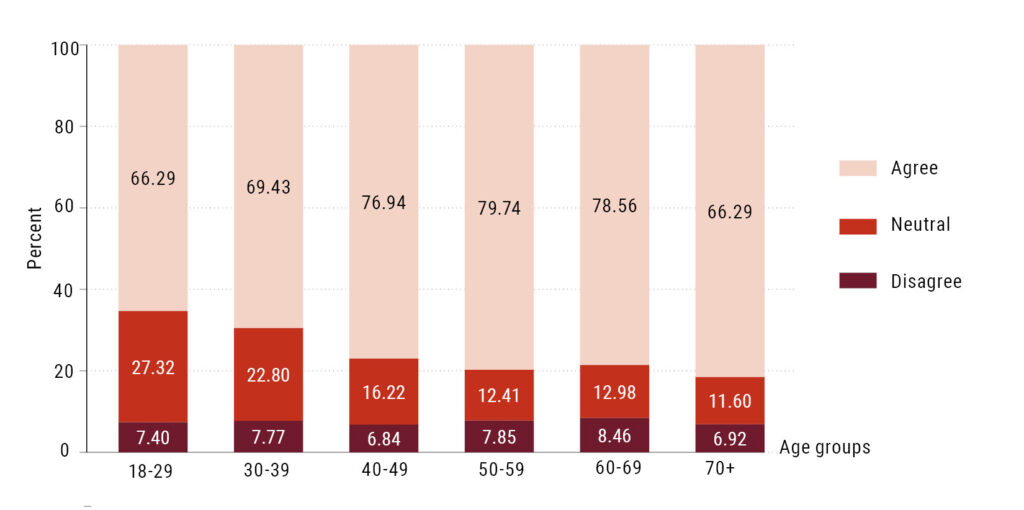
With regard to the interpretation of the Peaceful Revolution, our results show that a large majority of the population shares the view that it was a success story. Around 76% of respondents agree with the statement that the Peaceful Revolution was a success; fewer than 8% disagree with this statement. Approval is slightly higher in eastern Germany than in western Germany (80% compared to 74%). We can therefore almost speak of a broad consensus. However, as Figure 2 shows, this consensus is declining over time.
While over 80% of respondents over the age of 70 consider the Peaceful Revolution a success, this figure drops to 65% in the 18-29 age group, who have experienced neither life in the GDR nor the Peaceful Revolution.
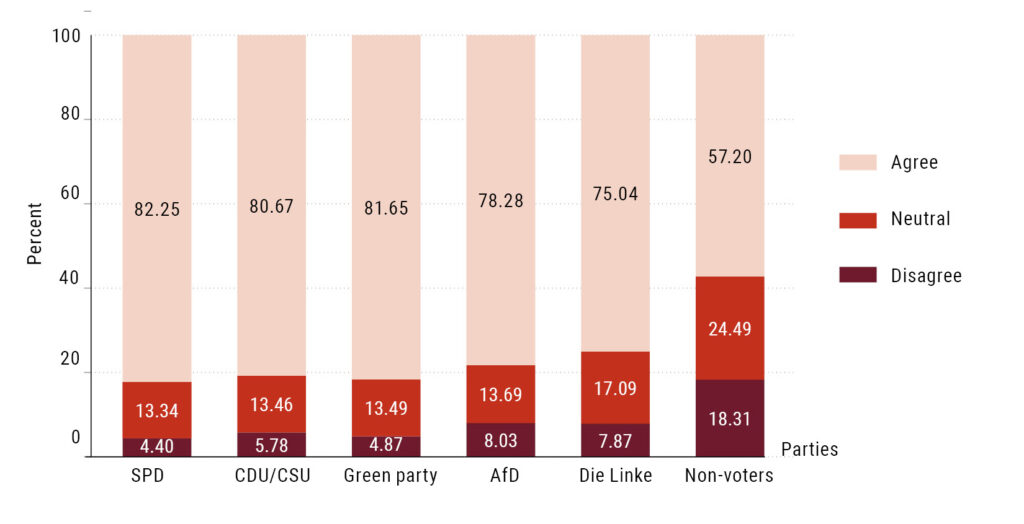
Interestingly, political preferences do not change this common interpretation much. Figure 3 shows support for the narrative of the successful Peaceful Revolution across party lines. Among the voters of the parties (voluntary self-disclosure) currently represented in the German parliament differences in support appear to be marginal. With more than 80%, support is especially high among voters of CDU, SPD and the Green Party and, correspondingly, the rejection rate is quite low (4.4 to 5.7 %).
Voters for the AfD (78%) and Die Linke (75%) support this interpretation to a lesser extent, yet still by a large majority. However, 7.9% and 8.0% of Die Linke and AfD voters, respectively, reject this interpretation more frequently. Both parties were quite successful in mobilizing young voters in the 2025 elections. We can therefore assume that younger voters in particular are responsible for the lower approval ratings of the narrative for both parties. Furthermore, as already mentioned, the AfD has been attempting to reframe the narrative of the Peaceful Revolution since 2019. Nevertheless, overall approval of the original narrative remains surprisingly high, even among voters for these parties.
Among self-declared non-voters, however, agreement with this narrative is significantly lower: only 57% agree with the idea of the Peaceful Revolution as a success story, while more than 18% reject it.
Overall, it can be said that the former consensus on the assessment of the peaceful revolution is beginning to crumble. With the decline in knowledge of the event among younger generations, the scope for interpretation is growing, and with it the chance for alternative narratives of failure or “unfinished business”. However, the results from our survey also show why the narrative of the peaceful revolution is particularly valuable from a democratic perspective. The group that abstained from voting during the 2025 national elections is the group among whom the rejection of the narrative of a successful peaceful revolution is by far highest. Conversely, support for the narrative appears to be linked to higher democratic participation.
Strengthening Remembrance Policy – Promoting Democracy through Historical Awareness
Knowledge of the successful peaceful revolution and its narrative is slowly crumbling, but the narrative itself is an enormous resource for democracy. It is therefore important to keep the memories of the Peaceful Revolution alive in order to counteract political and democratic alienation, especially among young citizens and voters. Against this backdrop, the laying of the foundation stone for the memorial in Leipzig is to be welcomed. At the same time, it is regrettable that the Peaceful Revolution continues to receive little attention as a positive reference point in German history in the German government’s recently published new memorial concept.
To counteract this forgetting, the German government should work to ensure the following:
- The monument in Berlin should be completed quickly and its impact should be scientifically evaluated. Until now, the selection of both monuments in Berlin and Leipzig has been based more on aesthetic and urban planning considerations than on their proven impact. An impact analysis can provide information on whether the memorials are actually having an effect and how this effect can be improved.
- Funding for further research should be available. In particular, research is needed into how the Peaceful Revolution can be embedded in an inclusive culture of remembrance and communicated in such a way that future generations, regardless of their origin and family background, can relate it to their own reality. This will be necessary in order to preserve the impact of the narrative in the future.
- The documentation of eyewitness accounts should be continued and advanced. A good foundation has been laid, among other things, by the Zeitzeugenportal (Contemporary Witness Portal). These efforts must be intensified in order to preserve this important resource and possibly form the basis for the development of AI-supported digital and interactive eyewitness formats, as is currently being tested in the field of Holocaust education.
- In the meantime, the federal government, under the leadership of the Federal President, should launch a program and provide funds to enable eyewitnesses to visit schools throughout the country. Alternatively, such projects could also be made possible through the federal program “Jugend erinnert” (Youth Remembers). These should be supplemented by specific workshops that provide guidance on how concrete concerns can be implemented in representative democracy in order to counteract political and democratic apathy and extremism.
- In which year did the Peaceful Revolution take place? (Answer options: 1987, 1988, 1989, 1990);
- In which city did the Monday Demonstrations, which ultimately led to the Peaceful Revolution, begin? (Answer options: Berlin, Leipzig, Dresden, Rostock)
- What famous phrase was chanted during the Monday Demonstrations? (Answer options: „We are one people!“, „We are the people!“, „Unity and justice and freedom!“, „Forward to freedom!“)
Additionally, we asked respondents about their support for six different statements about the Peaceful Revolution and German Unification. The wording for the question for which we report results here about the perceived success of the Peaceful Revolution was as follows:
- Please indicate how much you agree with the following statements, on a scale from 1 („not at all“) to 7 („very strongly“). “The Peaceful Revolution of 1989 was a success”
We report results with a categorical coding of support, where scores from 1 to 3 are categorized as disagreement, 4 as neutral, and scores from 5 to 7 as agreement. All results are reported with survey weights that correct for sampling imbalances to ensure the data are representative of German adult population. Weighting adjustments account for demographic factors such as age, sex, region, education, and political affiliation, based on the most recent census and other official public records.
This blog post is an English-language version of our previously published German-language PRIF Spotlight “Verblassende Erinnerungen der Hoffnung – Warum das Gedenken an die Friedliche Revolution gestärkt werden muss”.
This research was funded by the Diligentia Foundation.
Reihen
Ähnliche Beiträge
Schlagwörter
Markus Bayer
Latest posts by Markus Bayer (see all)
- Fading Memories of Hope and Empowerment? Why Remembrance of the Peaceful Revolution in Germany Matters and Needs to be Strengthened - 12. Dezember 2025
- Verblassende Erinnerungen der Hoffnung – Warum das Gedenken an die Friedliche Revolution gestärkt werden muss - 8. Dezember 2025
- Dealing with Germany’s First Genocide: Why Bilateral Negotiations with Namibia Failed and What the New Government Must Do - 26. März 2025

Felix Bethke
Latest posts by Felix Bethke (see all)
- Fading Memories of Hope and Empowerment? Why Remembrance of the Peaceful Revolution in Germany Matters and Needs to be Strengthened - 12. Dezember 2025
- Verblassende Erinnerungen der Hoffnung – Warum das Gedenken an die Friedliche Revolution gestärkt werden muss - 8. Dezember 2025
- Back in Business or Never Out? Military Coups and Political Militarization in Sub-Sahara Africa - 28. Dezember 2023