

The Never-Ending Transition: When Uncertainty Becomes the Norm
Four months after a coup interrupted the electoral process in Guinea-Bissau, political violence and repression against civilians and the media have contributed to an unending political transition while eroding democratic prospects. In a conversational collage, we bring together our perspectives as a peace and conflict researcher, a journalist and teacher, and as a media studies scholar. Taking the recent death of a political activist and threats against media houses as a snapshot of the moment, we reflect on a broader regional pattern in which transitional governments prolong their hold on power by strategically using political violence and uncertainty.
On 31 March 2026, the body of Vigário Luís Balanta, a political activist with the movement Pó di Terra, was found on the outskirts of Guinea-Bissau’s capital Bissau bearing signs of torture. In the following days, several media outlets in Bissau reported state repression, including orders to shut down media activities. In the wake of the coup that interrupted the presidential election of November 2025, these new incidents of political violence and restrictions on civil liberties worsen tensions over the country’s uncertain future.
Context: Election, Coup, and Reactions
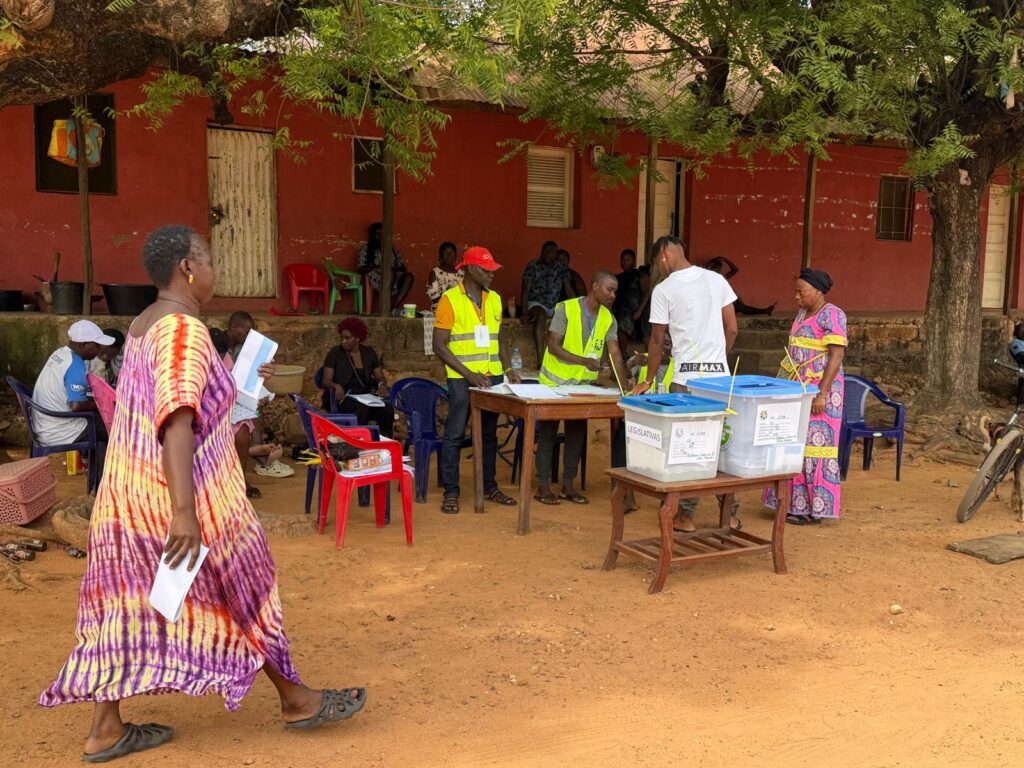
Despite a calm election day on 23 November 2025, unease grew as the country waited for the National Electoral Commission (CNE) to announce the election results. In the meantime, preliminary indications, such as sub-national election reports, suggested that the opposition had won the vote. At the same time, both main contenders publicly declared victory. To date, however, the CNE has not announced the election results.
On 26 November 2025, one day before the expected announcement, gunshots were reported at the presidential palace and at the offices of the CNE. Radio and television stations were shut down, a curfew imposed, and borders closed. Soldiers appeared on television declaring that high-ranking officers from the inner circle around former president Embaló had taken power. They annulled the results of the election, announced a one-year transitional government, and formed a 65-member transitional council that, among other actions, are thought to have changed the constitution without authority.
The official narrative articulated by deposed president Embaló about a military coup (“Golpe de Estado Militar”) and by the new transitional government about a rescue mission to save the country from a destabilising plot have been met with serious doubts.
The Economic Community of West African States, the African Union, and the United Nations initially took a clear stance by labelling the situation a coup, suspending the country, and embarking on a joint mediation mission. In Guinea-Bissau and beyond, however, several labels circulate to describe what happened.
Inside the country, Fernando Dias da Costa, the opposition candidate widely believed to have won the election, called the coup “inventado“ (invented), activist and journalist Armando Lona described it as a “golpe falso” (fake coup), while a headline of the Novo Jornal asked, “intentona ou inventona?” (attempted or invented?). Outside the country, former Nigerian president and election observer in the 2025 presidential election Goodluck Jonathan used the term “ceremonial coup”, while Senegalese Prime Minister Ousmane Sonko called it an “encenação“ (sham) and a “complô“ (conspiracy). Zooming out to consider the wider history and context of Guinea-Bissau, critics speak of a “slow coup”, arguing that over the past six years the now-deposed Embaló consolidated power by reshaping institutions, built a loyal ecosystem around himself, and overstayed his presidential mandate.
Much of the discussion online and in the media is highly speculative. Under the conditions of repression and uncertainty, both experts and ordinary people struggle to make sense of their experience. Yet it must also be noted that some public discussions are carefully manufactured political narratives. Amongst all this, however, is the certain fact that the coup interrupted the electoral process and prevented the announcement of the election results, resulting in an ongoing transition. In conversations on the streets and in online spaces, we find four key narratives:
#AvertingPlot. In official statements, the coup leaders—now the transitional government—claim to have uncovered a plot by politicians and drug barons to destabilize the country. They reject the label “coup,” portraying their actions instead as safeguarding the state.
#FakeCoup. Civil society organizations and opposition politicians voice doubts and accuse deposed president Embaló of orchestrating the coup to avoid defeat, to secure a face-saving exit from the country, and potentially to pave the way for re-election after a transitional period.
#VictimEmbaló. This narrative is articulated by deposed president Embaló and supporters, in defense against accusations of orchestrating this coup. Instead, he is portrayed as the victim.
#NothingNew. Beyond these diverging interpretations, there is also widespread resignation among Bissau-Guineans. Political turmoil is nothing new, hence citizens wait for it to pass. Only a few days until normalcy returns, markets reopen, and everyday life resumes.
Narratives like these do not emerge in a vacuum. Since independence, Guinea-Bissau has experienced repeated coups and repression of civil and media freedoms. These memories of past experiences shape how citizens interpret current events. How, then, do the present developments fit into the country’s chronic experience of crisis?
Two Signs, the Same Disease
Political transitions are supposed to move from point A to point B, even with diversions. The transition in Guinea-Bissau seems to have stalled halfway and set up camp. With no clear plan, each new crisis is used to justify previous indecision: “we can’t do X because of Y”; “we can’t resolve Y until Z has calmed down”. In this way, every challenging event becomes an excuse for inertia.
Such an endless transition normalizes what should only be an exception, allowing what was temporary to become permanent and emergencies to become routine. Under such circumstances, events like police violence against students cease to be scandals and become “procedure”, while the forced closure of a radio station ceases to be censorship and becomes “regulation”.
Violence and Silencing
Repressive practices, such as the crackdown on civil liberties and civilian life, characterize the ongoing transition in Guinea-Bissau. Two recent examples stand out:
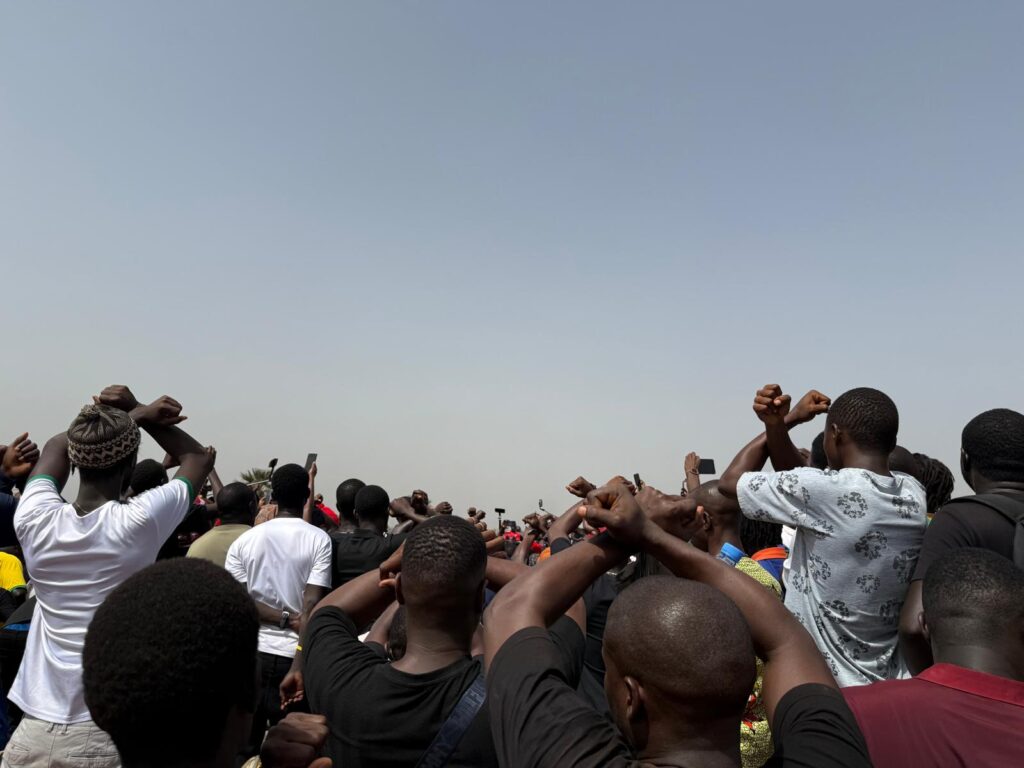
The first concerns violence against citizens: Vigário Luís Balanta died following an arrest that, according to family members and witnesses, involved physical attacks. The official account of his death remains unconvincing, and the independent autopsy requested by civil society has yet to be scheduled. In other words, while the names may change, the script stays the same: a young man, a working-class neighborhood, police violence, institutional silence. Within a week of Vigário Luís Balanta’s death, two protests in Bissau were dispersed with tear gas and baton charges. One was by students demanding overdue scholarships. The other, vendors in the main market Bandim protesting new municipal taxes. What they had in common were legitimate demands and a disproportionate state response. But when the uniform is used to silence, democracy suffers.
In the post-election context, police violence has become a familiar language of politics. It teaches that dissent comes at a cost, that public space is not truly public. This benefits those who profit from the endless transition, because without protest, without a free press, without societal pressure, there is no urgency to conclude anything.
The second example concerns crackdowns on radio stations: shortly after Vigário Luís Balanta’s death, the renowned Catholic radio station Rádio Sol Mansi reported that a mysterious fire disrupted its electricity supply. Several media outlets in Bissau reported they had been ordered to shut down for issues related to “licensing fees”, including the country’s first private radio station, Rádio Galaxia de Pindjiguiti and the private station Radio Capital FM/Capital News. The latter in particular has been repeatedly targeted for its critical stance in recent years. Justifying the shutdowns, the Communication Ministry cited a “lack of documentation” and “content that threatens public order”.
Shutting down radio in Guinea-Bissau means shutting down the public sphere. In a country where print newspapers circulate sparingly and the internet is unreliable, the radio is the parliament, the school, and the people’s court. Silencing the radio is decreeing that there is only one account of the facts. Reflecting on the coincidence of radio closures and mobile phone network outages, a representative from a peacebuilding organization suggested to us that a desire to delay and control public reactions to Vigário Luís Balanta’s death may lie behind both events.
While the affected radio stations continue to operate, the reaction reflects a recurring pattern: in politically tense times, Bissau-Guinean authorities have often restricted media and freedom of expression. Election periods are particularly telling. Ahead of the 2025 presidential election, repression of the media increased and international journalists were expelled.
Yet threats against radio stations are not just a technical issue regarding licenses. They are a test of the transitional government’s power. If they succeed, tomorrow it will be a newspaper. Then a website. Then a Facebook post—or hundreds. The target is not the FM frequency, but the very possibility of narratives beyond the official.
Consequences for the Public Sphere
The coup and the transitional government have further worsened conditions for media and civil liberties. Domingos Simões Pereira, leader of the independence party PAIGC and a former prime minister barred from the election, was arrested after the coup. He was later released but was placed under house arrest. Political parties face restrictions on assembly, the PAIGC has repeatedly been blocked from entering its headquarters, while demonstrations have been banned or violently suppressed.
During a transition, information is even more vital, since it helps clarify whether the process is transparent, whether deadlines are met, and whether commitments are genuine. When the transitional government tries to restrict radio stations, it clearly prefers to make the journey in the dark, without witnesses—but a transition without witnesses becomes a tunnel with no exit.
Vigário Luís Balanta’s death, batons on the street, microphones turned off: all speak of the impunity of those who attack, those who order attacks, and those who decide that certain voices cannot speak. Because closing the post-election cycle means being held accountable, impunity is the lifeblood of transitions that are not meant to end. And as long as the transition lasts, any reckoning or accountability can be put off indefinitely.
What Comes Next in a Transition Without End?
While many questions remain, this is not only a story of military coups but also of Guinea-Bissau’s political configuration, institutional performance, and long history of power struggles. It reflects a broader regional pattern in which transitional governments prolong their hold on power by strategically using political violence and uncertainty to manipulate public expectations.
National dialogue is off the government’s agenda and civil society has fractured due to co-optation. However, initiatives like “Bantaba di Paz”, organized by the civil society organizations Voz di Paz, WANEP and Forum de Paz, are one way to continue the conversation on the future of Guinea-Bissau. Despite restrictions, the media continues to be an important beacon of hope, increasingly receiving support from international actors.
For Guinea-Bissau, there is still a chance to choose another path, one where deaths are investigated, the police protect, the radio reports, and the political transition ends. But time is not infinite, nor is the people’s patience. Bissau-Guineans have been living for months in a kind of political limbo. For every Vigário Luís Balanta who dies without answers, every radio station that falls silent, every protester beaten, the country is brought closer to a point where transition becomes rupture. Democracy postponed, like justice postponed, is democracy denied.
Conclusions
To conclude the transition, several steps require the attention of Bissau-Guinean political forces, national, regional and international civil society networks, international partners, and international organizations:
First, reject normalization. Vigário Luís Balanta’s death is not “just another single case.” He is a citizen with a name, a family, and rights. Demanding an independent investigation with the participation of the Bar Association and the Human Rights League is not political opposition, but upholding the rule of law.
Second, restore the police to their proper role. The use of force has rules; dispersing a peaceful demonstration with violence is illegal. The Ministry of the Interior must publish operational protocols and hold accountable police commanders who violate them.
Third, take radio stations off the target list. Regarding licensing issues, provide a deadline and support to resolve them. Democracy is not built in silence. The transitional government that fears the open microphone has already admitted: it is here to stay.
Fourth, demand a timeline. National political forces, UN, AU, ECOWAS, the CPLP, and civil society must put a public timeline on the table, making clear when the budget is finalized, how the independence of the National Election Commission (CNE) and the Supreme Court is ensured, and when the transitional government will hand over power. This necessitates strengthening diplomatic efforts in dialogue with the transitional government. Without a timeline and renewed efforts, everything that happened recently will happen again next week.
Reihen
Ähnliche Beiträge
Schlagwörter

Sophia Birchinger
Latest posts by Sophia Birchinger (see all)

Mamandin Indjai
Latest posts by Mamandin Indjai (see all)
- A transição que não acaba: Quando a incerteza se torna método - 22. April 2026
- The Never-Ending Transition: When Uncertainty Becomes the Norm - 17. April 2026

Johanna Mack
Latest posts by Johanna Mack (see all)
- A transição que não acaba: Quando a incerteza se torna método - 22. April 2026
- The Never-Ending Transition: When Uncertainty Becomes the Norm - 17. April 2026