25 Years of Women, Peace and Security: Envisioning A Future by Centering on Hope
In the wake of the 25th anniversary of the Women, Peace and Security Agenda, we bear witness to a difficult time for global feminist visions and futures. In this piece, we turn towards hope as an inherently feminist concept and a guide to upholding principles of solidarity, community, and care. It is our firm belief that looking for signs of hope, in both the past and the present, will help us envision a future for the WPS agenda that opens pathways to its survival and transformation. This piece is an invitation for a dialogue amongst members of civil society, academia, policy makers, artists, media, and legal professionals to collaboratively re-imagine the canvas of WPS as it adapts itself to the needs of current times and makes itself future relevant. Finally, it is a call to hold on hope as a bridge to what ought to be.
“Many stories which are not on paper, are written in the bodies and minds of women.” – Amrita Pritam
Writing at a time when the Indian subcontinent was undergoing colonial partition, the work of Indian poet Amrita Pritam invites us to consider the central role of women in carrying the ebbing and flowing narratives of human existence. Women in such roles often find themselves negotiating many dichotomies: past and future; public and private; waging violence and building peace. These experiences shape their everyday in myriad ways; at homes, in marketplaces, at work, or in classrooms, playing a critical role in fusing the fragments of yesterday into tapestries of renewal. They bring a sense of hope that women carry within themselves, affording them the solidarity necessary to build peace across all borders and faultlines. Looking at 25 years of the United Nation’s Women, Peace and Security (WPS) agenda, it is this hope that we wish to weave into the pillars of women’s peacebuilding leaders, even in times of despair and turbulence.
Practicing Hope
As we write this article, in the context of the contemporary world that is grappling with the multilayered challenges of climate change, genocide, conflicts and wars, failures of governance, and global health challenges, we wish to hold on to the eternal spirit of possibility that hope offers. In writing this article, we sought to ground ourselves in the notion of hope to find subtle, yet powerful, pathways to peace. Despite coming from different cultural and academic backgrounds – those of South Asia and Europe – as young feminist scholars of peace and security we drew on our combined strengths, converging on diverse experiences and expertise. Sitting down and recording parts of a conversation at a café over Idli with music, chatter and sounds from the kitchen in the background – we found both surprising and familiar synergies and potential.
As feminist early-career researchers we seek to envision the future of transnational feminist practice in the spirit of solidarity and feminist co-creation of knowledge. This conversation was both an exercise to pause and reflect and to remove ourselves from feelings of apathy or helplessness. In these turbulent times, when we are engulfed with questions and dilemmas, we decided to find our footing within the feminist ideas of forging solidarity and dialogue. In other words, we sought refuge in the hope that WPS will find renewed meaning and relevance; the hope that the world will look to feminist ideals of peace and security; the hope that peacebuilding will be built on the ideals of inclusion, justice, and equity. Nimmi Hutnik’s painting encapsulates this hope beautifully. The painting above represents the structural inequalities that black and minority ethnic women face in Britain. The rich and varied cultural backgrounds of BAME women are often forgotten but captured here by the use of found objects, in this case earrings, and tropical animals and insects. The yellow of the background in this intergenerational, interethnic painting symbolizes solidarity, light and the hope for greater equality in pay.
Hope as a Means towards the Future
What is hope and how can it help us make sense of 25 years of the WPS Agenda? For over two months we mobilized reflections on hope through the lens of feminist peace. Hope here becomes an anchor for the irrevocable belief in achieving social justice and security. Hope fuels the struggle against all kinds of inequalities and marginalization to leverage peace. It becomes political by rejecting the surrender of these fundamental feminist principles and by allowing it to craft spaces in which feminist solidarity can thrive and be practiced. As an intrinsically human condition, it means not giving up, it means holding on to solidarity, irrespective of the myriad and differing obstacles. We believe that hope remains key to give the WPS agenda life, keeping it afloat in today’s turbulent waters.
Moments of Hope in the Past
In the past, women across borders and boundaries have practiced and created encounters through discussion, bridging geographic, religious, and cultural differences to find similarities and transcend the divisions of the modern nation-state. These practices were driven by a hope for peaceful encounters and for the capacity to see and listen to each other; the hope for the creation of community. We turn towards two historical moments of solidarity in which women gathered and built community, understanding them as occasions that were carried by hope and which may still guide us towards a hopeful future.
Women’s Peace Train 1995
Prior to the ratification of the WPS agenda, in 1995, the United Nations hosted their first-ever Women’s Conference in Beijing, China. In the runup to the conference, the Women’s International League for Peace and Freedom and other civil society actors organized the Women’s Peace Train, on which women activists from across the world traveled from Helsinki, Finland to Beijing. On this 22-day journey, they gathered for political sit-ins and roundtables with local activists and researchers, went about cooking, laundry, music and dancing sessions. Through these extraordinary and everyday practices, women navigated new ways of negotiating for peace in exploring their shared needs, differences and similarities in livelihoods. These practices for peace and solidarity informed the Beijing Declaration and Platform for Action, the first ever declaration of its kind. It had a direct impact on the future of UN Women and the adoption of principles for gender equality and justice. Until this day, the Peace Train’s legacy is remembered as a moment of transnational feminist community that enabled visions for peace and hope, which, in turn, catalyzed friendship, learning and understanding across borders.
Transnational Feminist Solidarities across Digital Spaces
In 2022, after two brutal femicides in Egypt and Jordan, feminist activists initiated a strike under the slogan “Solidarity across Borders” to protest the lack of support infrastructures for women affected by gender-based violence (GBV) in the region. As scholar Bronwen Mehta has shown, activist’s framing as “women of the MENA region” created digital transnational spaces of resistance that addressed both women residing in the region as well as diasporic communities. The strike and its aftermath demonstrated the potential and hope for regional, cross-border activism highlighting the necessity to organize against GBV and patriarchy.
Towards Moments of Hope in the Future
Nearly two generations of civil society actors, NGOs, and grass-roots activists have been holding on to hope in order to shape, challenge, and advance the WPS agenda. Among other things, it opened discussions around the definition of security and insecurity, the multiple ways women are affected by and contribute to war and conflict, and how women might shape, advance and negotiate meaningful and lasting peace. In writing this article, our aim is to ask how these examples of hope can help us make sense of the future of the WPS Agenda. What can feminist scholars, practitioners and supporters learn from these women and their hope for a better future?
These two stories show us that cross-border exchange is for keeping the hope for peace alive, a spirit that has fueled feminists pushing for the agenda to come to life. As we move forward, we look for potential points of solidarity with other agendas, such as the Youth, Peace and Security (YPS) of the United Nations Security Council (through Resolution 2250). Recently celebrating its 10 year anniversary, YPS seeks to increase the role of young people in decision making spaces. How can we, as feminist communities, strengthen our work through collaboration? How can we nurture pathways towards shared goals and aspirations of peace? As the future of the agenda is in peril, its supporters must (re)strategize how to save women’s rights. Contemporary moments of hope emerge as women activists move to digital spaces to connect and practice solidarity beyond the confines of national and regional borders. Undeniably, the present and future of digital spheres complicate the meaning of security and produce novel forms of insecurity. But these digital worlds can also leverage action. Considering women’s roles and agency in creating feminist spaces through online mobilizations offers a perspective of hope in this digital era that can help carry onward the legacy of WPS.
Future Pathways
Writing this article collaboratively, our aim was to bridge the distance between the Global South and North. We carried with us the echoes of the many women who have inspired us through their activism, diplomacy, writings, or by sharing their personal experiences. For over a decade these women have been instrumental in shaping the ideas of WPS that we carry in our minds and hearts, encouraging us to pursue the hope-filled principles of feminist organizing and transnational feminism. With this article, our aim is not to reiterate the reasons why the future might look bleak, but instead, despite the strong and often chilling wind, to keep the candle of hope aflame.
Artwork by Nimmi Hutnik: BAME Sisters: The Gender Pay Gap. Oils on canvas.90x90x4cm. © Nimmi Hutnik
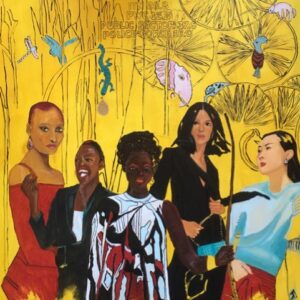 This painting represents the structural inequalities that black and minority ethnic women face in Britain. The statistics at the top of the painting come from a white paper produced by the UK government in 2018 detailing the gender pay gap between ethnic minority women and their white female counterparts within a UK TV network, Price Waterhouse Coopers, the police force and the public sector. The rich and varied cultural backgrounds of BAME women are often forgotten but captured here by the use of found objects, in this case earrings, and tropical animals and insects. The yellow of the background in this intergenerational, interethnic painting symbolises solidarity, light and the hope for greater equality in pay.
Reihen
Ähnliche Beiträge
Schlagwörter
Diksha Poddar
Latest posts by Diksha Poddar (see all)

Latest posts by Madita Standke-Erdmann (see all)
- 25 Years of Women, Peace and Security: Envisioning A Future by Centering on Hope - 18. Februar 2026
- Der Kampf um Körper und Identität: Rückschritte sind zu befürchten - 17. Februar 2025