

Israel’s 2026 Elections: October 7 Looms, Domestic Issues Dominate
On October 27, 2026, Israel will hold a critical election – the first since Hamas’ terror attack on October 7, 2023 and the subsequent war in Gaza. Seeking reelection is Prime Minister Benjamin Netanyahu, who has split Israel’s politics into two main blocs. Netanyahu’s opposition is united in curbing Jewish terrorism in the West Bank and investigating the failures in the lead-up to October 7. Still, no bloc supports a two-state solution with Palestinians. German policymakers should present clear measures to bolster the security of both Israelis and Palestinians, regardless of the election results.
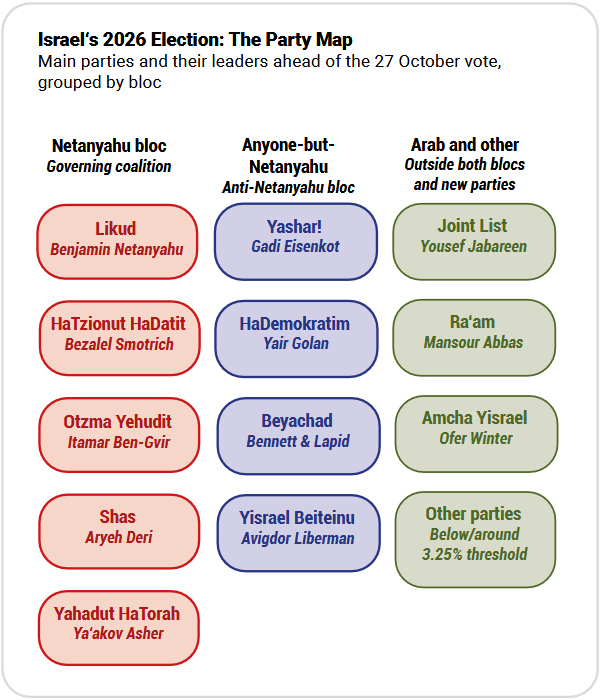
Benjamin Netanyahu, who first served as Prime Minister (PM) from 1996 to 1999, has been in office since 2009, aside from the year-long “change government” headed by rotational Prime Ministers Naftali Bennett and Yair Lapid (2021-2022). He is Israel’s longest serving PM and in recent years has been embroiled in a court trial on indictments on bribery, breach of trust, and fraud; a trial which has deeply divided Israelis. In addition, his government’s failure to prevent the October 7 attack has stirred controversy. As a result, Netanyahu`s candidacy is reinforcing the division of Israel’s multi-party system largely into two informal blocs: the “Netanyahu bloc” and the “Anyone-but-Netanyahu bloc”1.
Beside the main two blocs are the Arab parties. They have been historically ostracized from Israeli governments, except for the “Ra’am”, which took part in the Bennett-Lapid government – a first for an Arab party in Israel. Yet, publicly at least, politicians from both blocs have so far ruled out relying on the Arab-led parties.2 Other small parties outside the blocs are currently polling below the electoral threshold (3.25%) or floating just above it. Some politicians in this group have called for a unity government including Jewish-led parties from both blocs, promising to rise above bloc politics and censures.
Polling over the past few months shows that the “Netanyahu bloc” could struggle to obtain a plurality in the Knesset.3 However, the “Anyone-but-Netanyahu bloc” also lacks a majority in polls if the Arab parties are discounted. The bloc’s leading challenger to Netanyahu seems to be Gadi Eisenkot, party leader of “Yashar!”, although other leaders in his bloc have not endorsed him. Eisenkot, 66, rose through the ranks to become Chief of the General Staff of the Israel Defense Forces (IDF) from 2015 to 2019, appointed by Netanyahu. He is seen as a cautious, soft-spoken figure of the security establishment who appeals to voters by calling for accountability for the failures of October 7. The seasoned politician Netanyahu, by contrast, is considered “Mr. Security” by his constituents and known for his rhetorical skill and close ties to the current US administration.
The Israeli-Palestinian Conflict: Post-October 7
Hamas’ surprise terror attack on October 7 has been etched into Israeli collective memory as a national trauma reviving the memory of the Holocaust. Hamas carried out an attack on Israeli communities and military bases in southern Israel that led to the killings of 1,200 people and resulted in at least 250 people taken hostage.
In the Israeli public, October 7 reinforced the belief that there is “no partner” for peace on the Palestinian side. Support for a two-state solution had long been dropping among Jewish Israelis from 70% in 2007, to 46% in 2018, and to 24% in 2025.4 Since October 7, the mutual mistrust between the two sides has reached unprecedented heights: In 2024, a poll showed that 93% of Jewish Israelis attributed maximalist and genocidal aspirations to the Palestinians; likewise, a vast majority of Palestinians (88%) attributed such aspirations to Israel.5 Netanyahu echoed such sentiments when he called the recognition of Palestinian statehood by European states a “reward to terror”6.
Militarily, the attack led to a collapse of Israel’s strategy to “manage” the Israeli-Palestinian conflict. October 7 triggered an Israeli offensive that caused unprecedented destruction across the region, especially in Gaza. According to human rights organizations and senior IDF officials, who in January 2026 corroborated the Gazan Ministry of Health, more than 73,000 people have been killed in Gaza since the war began.7 A “ceasefire” brokered by President Trump in October 2025 freed the remaining living Israeli hostages but has not stopped the devastation. The UN reports that the IDF continues the destruction,8 with Israel now controlling more than 60% of Gaza and Hamas still on its feet. What is more, the implementation of phase II of the “Gaza Peace Plan” formulated by Trump’s “Board of Peace” to stabilize and disarm Gaza has yet to gain traction.9 Meanwhile, Jewish settler terrorism against Palestinian communities in the West Bank has intensified, and the government has approved over one hundred new settlements.10
Ahead of the upcoming elections, no major contender is willing to engage with the idea of Palestinian statehood. This includes leaders of the opposition, who, prior to October 7, expressed support for various arrangements to separate from the Palestinians, be it through territorial swaps or unilateral steps.11 All in all, no political result in the election will yield a push for direct engagement with the Palestinians, although the opposition to Netanyahu has voiced interest in promoting regional initiatives that could incorporate them.12 While rejecting a two-state-solution, Jewish-led opposition parties have criticized the loss of control in the West Bank and called for the IDF to fight Jewish terrorism against Palestinians.13
Israel’s International Isolation
In the immediate aftermath of the October 7 attack, Israel was backed by much of the international community, including Germany. Three years later, Israel’s military campaign on multiple fronts has sparked global concern and inquiries into violations of international humanitarian law. Netanyahu’s government has alienated some of Israel’s closest partners and many publics around the world. Israel also faces mounting legal exposure. UN bodies and NGOs have accused Israel of war crimes. South Africa has brought a genocide case against it before the International Court of Justice. The International Criminal Court has issued arrest warrants for Prime Minister Netanyahu and former defense minister Yoav Gallant.
In Europe, relationships with Israel have soured to varying degrees, due to the severe humanitarian crisis triggered by the war in Gaza and its condoning of extreme settler violence in the West Bank. Germany, for its part, has sought to reconcile its Staatsräson commitment to Israel‘s security with mounting criticism of Israel‘s military conduct. Consequently, Berlin‘s position on the application of international humanitarian law to the conflict has been conspicuously inconsistent. Its attempt at a nuanced position is informed, on the one hand, by Germany‘s historical responsibility toward Israel. On the other hand, Germany wants to exercise its strategic leverage over the Israeli government to promote a negotiated two state-solution. Germany also enjoys high popularity among Israelis. A public survey conducted in June 2026 shows that after the US, Germany is the country Israelis most often name as important to Israel (45%).14 However, most Germans oppose the war and believe Israel has committed war crimes since October 7.15 If it stays in power, the incumbent government does not seem keen on mending relations with Europe, and will continue fostering partnerships with governments which abstain from critique. The Jewish-led opposition parties have framed Israel’s international isolation as a product of the Netanyahu government’s rhetoric and diplomatic inaction. These parties are interested in thawing relations with Europe, but they will be reluctant to agree to a two-state solution.
A Destabilized Middle East
Israel’s post-October 7 war quickly expanded beyond Gaza to the self-proclaimed “axis of resistance”, a network of Iranian-backed armed groups and allied state actors.16 But while Israel (and the US) have degraded its military capabilities, the network remains intact. Israel has adopted a buffer-zone strategy along its borders and occupied parts of Gaza, Southern Lebanon and Southern Syria. With Iran, tensions have remained high since Israel and the US began a joint military operation in late February 2026.
The post-October 7 wars have also strained Israel’s relations with regional partners such as Egypt, Jordan, and the “Abraham Accords” countries, with normalization with Saudi Arabia and other states currently out of reach. Ahead of the elections, both blocs concur on a hawkish stance towards Iran and the “axis of resistance”, but they diverge on the ways and means of Israel’s broader approach to the region. A Netanyahu-led government would likely maintain inflammatory rhetoric and sustain military control beyond Israel‘s borders, which could further unravel Israel‘s relations with regional partners. The opposition intends to revive diplomatic engagement with partners through regional initiatives, although its opposition to a Palestinian state might be a stumbling block.
Israel’s Domestic Issues
Ahead of the elections, Israel’s domestic issues are what dominate the political agenda. Still, these issues seem to be closely entangled with Israel’s conflict with the Palestinians. First, in January 2023 the government launched a push to “reform” the judiciary and limit the rule of law. Critics argue that the overhaul of the judicial system was at least partly aimed at removing legal roadblocks to tighter control, expanding settlements, and advancing the annexation of the West Bank. Second, shortly after October 7 a majority of Jewish Israelis called for Netanyahu’s resignation and demanded a national commission of inquiry into the failures leading up to October 7 – to no avail.17 Third, the near-complete exemption of Ultra-Orthodox Jews from military service in the IDF is highly controversial. The war’s human toll on the Israeli side accentuated unequal societal burden-sharing, such that the draft exemption for the Ultra-Orthodox has become a highly contentious election issue.
Beyond these issues, the election is a referendum on the ethos of Israel. The results could be a litmus test for where Israel heads next, especially since a poll in July 2026 found around 70% of Israelis expressing fear about the integrity of the upcoming elections.18 A successive Netanyahu government would continue its “reforms” of the judiciary and pursue the further embedding of traditional Jewish rules and laws into the public space and institutions. The political platform of the opposition focuses first on establishing a public commission of inquiry to investigate the failures that led to the October 7 attacks and on undoing legislation pushed by the incumbent government. The opposition would also attempt to integrate the ultra-orthodox into the rest of Israeli society, inter alia removing their exemption from military service.19
Conclusions
If Israel’s opposition wins the elections on October 27 and is able to form a government, Germany and its European partners will breathe a sigh of relief. The extreme rhetoric and disturbing actions of Israel’s most right wing-government ever would halt, at least temporarily. The opposition has voiced criticism of Jewish settler terrorism in the West Bank, called for an investigation of the state’s failure to prevent the October 7 Hamas attack, and promised to roll back the assaults on Israel’s state institutions.
However, this should not obscure the fact that the opposition shares the current government’s fundamental stance on Palestinian statehood as well as on Israel’s security strategy. Against the backdrop of October 7, the belief that a Palestinian state poses a major threat to national security has been reinforced. A two-state solution had lost support long before, now it seems unattainable. Tensions with Iran will likely continue as both the current government and the opposition view the regime in Tehran and its proxies as Israel’s greatest threat. Therefore, German policymakers should not expect overwhelming changes regarding the basic parameters of the conflict if a new government takes over. However, beneath the surface, the parties of the “Anyone-but-Netayahu” bloc do hold diverging views on how to proceed in the Palestinian issue – and it will be crucial for Germany to utilize its levers without endangering a fragile coalition.
Germany’s chancellor has recently avoided talking about Israel’s security as German “Staatsräson”20, presumably to gain more flexibility in dealing with the Netanyahu government and rejecting any plans for the annexation of Palestinian territories. Germany should continue this path and take steps promoting security for both Israelis and Palestinians. First, regarding the Gaza peace plan: flawed as it is, it is currently the only internationally recognized way forward. Germany can help turn it into practice by contributing to reconstruction, supporting the Palestinian technocratic committee, and offering expertise for Disarmament, Demobilization and Reintegration (DDR). Second, Germany should align with Europeans, making Israel’s association agreement conditional upon a stop to Jewish terrorism in the West Bank and further settlement enlargement. Third, it should support the Palestinian Authority’s governance reforms and empower both sides to improve security coordination and civilian cooperation.
 Download (pdf, barrierefrei): Levy, Ilai Yaron; Baumgart-Ochse, Claudia (2026): Israel’s 2026 Elections: October 7 Looms, Domestic Issues Dominate. PRIF Spotlight 15, Frankfurt/M. DOI: 10.48809/prifspot2615.
Ilai Yaron Levy, Claudia Baumgart-Ochse