Criminal Violence and Repression: Civic Activism in Ecuador and Noboa’s “Internal Armed Conflict”
Between 2019 and 2025, Ecuador’s homicide rate increased from 7 to 51 per 100,000 inhabitants – the highest in Latin America. In early 2024, President Daniel Noboa responded to this criminal violence by declaring an “internal armed conflict”. A recent Spanish-language PRIF Report shows that this hardline response comes with serious restrictions on civic activism. Civil society actors are thus under pressure from both criminal violence and state repression. This Spotlight summarizes the consequences of this twin challenge for civil society actors as well as their responses. It concludes with recommendations for external actors engaged in Ecuador.
Only a few years ago, Ecuador ranked among the safest countries in Latin America. However, a steep increase in criminal violence inside the country has resulted in a recorded homicide rate of 51 per 100,000 in 2025, a national record and the highest rate in Latin America. This surge is driven by the growth and fragmentation of criminal groups linked to international criminal networks, including competing Mexican cartels, Colombian armed groups, and European mafia organizations. These groups fight both one another and the state for control over expanding illicit economies, above all transnational drug trafficking but also illegal mining and local protection rackets.1
In January 2024, Ecuador’s President Daniel Noboa responded to a further escalation of criminal violence by declaring an “internal armed conflict” and deploying the military to the streets and prisons. Since March 2026, Ecuador and the United States have been conducting joint military initiatives on Ecuadorian territory. This militarized fight against organized crime comes with serious human rights violations, including arbitrary detentions, forced disappearances, and unlawful killings.2 Under the guise of fighting crime and violence, the Noboa government has also adopted legal measures that restrict the space for civic activism, while protesters have faced violent state repression and prosecution. Civil society organizations (CSOs), social movements, community associations, and activists – especially human and environmental rights defenders – face a twofold threat from criminal groups that control territory and use violence and from a state that imposes additional restrictions and delegitimizes dissident forms of civic activism.3
In this PRIF Spotlight, we summarize key insights from the PRIF Report Activismo y Movilización Social en Tiempos del ‘Conflicto Armado Interno’, which is freely available at https://doi.org/10.48809/prifrep2602. The study draws on assessments and experiences of Ecuadorian civil society actors – collected through interviews and workshops – including Indigenous, environmental, and human rights organizations, community and neighborhood activists, as well as CSOs working in violence-affected territories.
Criminal Repression
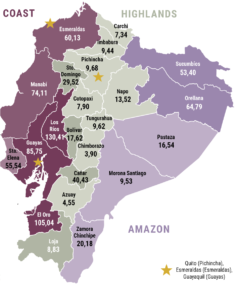
The territorial presence and violence of criminal groups vary considerably across Ecuador. Given their strategic role in transnational drug trafficking, the coastal provinces and border regions are particularly affected. With the expansion of illegal mining, resource-rich provinces in the highlands and Amazon region are also increasingly exposed to criminal activity (see Map). Civil society actors in these provinces are directly confronted with what we call criminal repression: the imposition by criminal groups of obstacles and risks on the organization, mobilization, communication, and activities of civil society.
The individuals and organizations consulted for our study emphasized three main ways in which they are affected by criminal repression: i) erosion of organizational capacity, ii) undermining of trust and community structures, and iii) diversion of financial and human resources.
First, dealing with threats, intimidation, and extortion weakens organizational capacity. Constant fear paralyzes activists and reduces the willingness to participate in CSOs and gather in public spaces. The psychological weight of sustained exposure to violence further erodes organizations’ capacity to act and sustain participation. This most directly affects grassroots activists and organizations, but also national-level CSOs that work with and in violence-affected communities.
Second, criminal repression severely harms relations between civil society actors and local communities. In many affected areas, criminal groups recruit members, including children and adolescents, from local communities, making it hard to identify threats. This uncertainty creates distrust, eroding community structures and hindering everyday forms of civic activism.
Third, working in contexts of criminal violence requires adapting one’s scope of action, with the result that civil society actors are forced to devote more time and resources to their own protection. They also recognize the need to redefine their priorities to focus on the immediate challenges facing local communities. For example, organizations have started to address the criminal recruitment of children and adolescents.
The lack of state protection is an additional burden for civil society actors. Security operations in affected territories tend to be brief and are rarely followed by lasting change. Once state forces withdraw, communities, social leaders, and CSOs are often left exposed to reprisals by criminal groups and other significant risks. Among civil society actors the justice system is perceived as ill-equipped, unable, and indeed unwilling to confront organized crime, a posture that reinforces their exposure to criminal repression. In addition, corruption and collusion between criminal and state actors mean that denouncing criminal violence can be both dangerous and futile. As a result, the state lacks both the capacity and the political will to protect civil society actors from criminal violence.
State Repression Under the Guise of Security
The Noboa government’s declaration of an “internal armed conflict” restricts civic space in many ways. Whether intentional or not, security policies have directly repressive effects on civil society actors. Ecuador lives under an almost permanent state of exception, a central political tool in the fight against organized crime that also limits civil liberties.4 State security operations against criminal groups also have repressive side effects. Local and international human rights organizations frequently denounce the serious human rights violations that accompany such operations, including excessive use of force, extrajudicial killings, and forced disappearances.5 According to testimonies and further reports, this state violence also affects activists and community leaders and is, at times, perceived as deliberately targeted at them.
The fight against organized crime is also used to justify a broader set of restrictive policies. This became particularly evident during mass protests in September and October 2025. When Ecuador’s Indigenous movement called for a “national strike” after fuel subsidies were removed, protests were met by heavy police and military deployments using tanks, tear gas, and live ammunition. UN human rights experts criticized the “unnecessary and disproportionate use of force”, while local human rights groups reported three deaths, 473 injuries, 206 detentions, and 16 short-term disappearances.6 Civil society actors have also faced criminalization and legal prosecution for their involvement in or support for the protest, with 61 individuals, including prominent Indigenous leaders, investigated for alleged unjustified private enrichment. Others faced terrorism charges while the bank accounts of individuals or entire CSOs were frozen.
Repressive responses to the 2025 strike are embedded in a broader set of legal initiatives. Again, the key justification is the fight against organized crime, and specifically, the aim of preventing money laundering and support for criminal or terrorist activities. However, national and international human rights organizations have pointed out that such measures limit the freedoms of association, assembly, and protest, and can be exploited politically to target organizations that challenge government policies.7 The most prominent legislation in this regard is the 2025 ‘Social Transparency Law’, which expanded the state’s capacity to surveil, control, and sanction CSOs (see Box).
These policies are also embedded in a broader political narrative, pushed by the Noboa government and amplified by certain media. Civil society actors defending human rights, including Indigenous and environmental rights, are indiscriminately portrayed as somehow being involved in or supportive of illicit activities, organized crime, or terrorism. This turns public opinion and security forces against these groups and increases the risk of criticizing the government.
Civil Society Responses and Their Limits
Faced with this twofold challenge, civil society actors have developed a repertoire of overlapping strategies. These include adaptation: ensuring the survival of CSOs in adverse contexts; (hidden) resistance: counteracting violence and repression, even if only gradually or indirectly; and prevention: preempting new restrictions by the state or criminal groups at an early stage.
For most civil society actors in highly violent contexts, (un)official security protocols, mutual support structures, and (mental health) staff-care initiatives are now commonplace. CSOs also seek to strengthen existing community structures as a means of self-protection against criminal actors. Adaptation further includes the strategic calibration of visibility: in some contexts, greater public exposure offers a form of protection, while in others civil society actors may lower their profile, adjust their language, avoid sensitive issues, or withdraw from the public sphere entirely. CSOs also cooperate with local leaders to navigate these territories, but in many cases cannot avoid negotiating their access and activities with criminal groups. They generally refrain from entering violence-affected communities alongside state security forces, as this undermines community trust and increases exposure to criminal retaliation.
To counter state repression, organizations document abuses and rights violations, seek legal advice and pursue legal action both nationally and, once Ecuadorian legal paths are exhausted, at the international level. They strengthen mutual support, forge national and international alliances, and develop counternarratives to combat the government’s portrayal of activism as a front for crime or terrorism. Preventive strategies, finally, include measures to strengthen awareness and understanding of child recruitment by criminal groups.
These strategies help Ecuadorian civil society actors to navigate a difficult and still relatively new context. Yet these responses also have limits. Protecting oneself requires substantial amounts of time and financial resources that would otherwise be spent on substantive civic activism. Many organizations have had to adjust their work, resulting in self-censorship, retreat from the public sphere, or the temporary suspension of activities. This retreat is reported especially by grassroots actors working in areas where there are both strong criminal groups and an absent or even repressive state. Other organizations try to continue their efforts, albeit on a somewhat smaller scale due to a lack of resources.
Conclusion and Recommendations
Our study shows that the deterioration of civic space in Ecuador cannot be reduced to collateral damage of increasing criminal violence and the Ecuadorian state’s fight against it. Instead, it constitutes a problem in its own right. Additionally, the Noboa government’s tough-on-crime policies have not improved the overall security situation in Ecuador.8 Yet regardless of one’s position on the government’s broader security agenda, the findings call for a debate on how to better balance the response to organized crime with the protection of human rights. More efforts are needed to mitigate the repercussions of criminal violence and tough-on-crime policies on civil society actors in Ecuador.
While the primary responsibility for protecting civic space lies with Ecuadorians themselves, external actors can help. In our conversations, representatives of Ecuadorian CSOs made it clear that international attention, solidarity, and support remain important. To this end, our study offers five recommendations for external actors cooperating with Ecuador, including German and European governments, governmental development agencies, and international NGOs:
- Publicly support human rights defenders. Consistent international attention and visibility, careful documentation, and vocal solidarity lower risks for and strengthen the legitimacy of those under threat.
- Maintain a frank human rights dialogue. Ecuador’s constitution and its international human rights obligations should remain a fixed reference point that international partners raise consistently and critically in both diplomatic dialogue and development cooperation.
- Strengthen protection and emergency-response mechanisms. Maintain and expand mechanisms of protection and emergency support for individual activists and organizations, enabling a rapid response to threatening situations, both inside and outside Ecuador.
- Provide predictable but flexible funding. Civil society organizations need long-term financial support that is flexible and unbureaucratic enough to let them quickly adjust activities and priorities as risks change.
- Facilitate exchange between organizations and countries. International cooperation could assume a key role in facilitating exchange among organizations facing similar challenges, in the region (e.g., Colombia or Mexico) and beyond.
Acknowledgments:
The authors thank Anahí Macaroff and Tina Hennecken Andrade of the Friedrich-Ebert-Stiftung in Quito for their collaboration as well as the participants in the workshops and interviews for sharing their experiences with us. Claude (Anthropic, 2026) was used at an early stage of this PRIF Spotlight to help summarize the preceding study and help with the structure. The final text is our own, and responsibility for the content and arguments remains with the authors.