

Thirty Years of Onion Politics: Bosnia and Herzegovina on the 30th anniversary of the Dayton Peace Agreement
The Dayton Peace Agreement ended the Bosnian War, establishing the constitutional framework of Bosnia and Herzegovina. It achieved its immediate aim of ending direct violence, yet ended up creating a state apparatus that obstructs social equality and economic sovereignty. This Spotlight argues that the evaluation of its success must take two problems into account: the cementation of ethnic categories as foundational levels of governance and the resulting failure to address or transform war legacies; and the institutionalized international involvement undermining democratic self-determination.
Thirty years after the end of the war, a popular joke in Bosnia and Herzegovina compares the state to an onion: it has many layers—and it’s bound to make you cry. The metaphor captures a political reality: The Dayton Peace Agreement, signed on 14 December 1995 in Paris, divided the republic into two ethnically defined entities (the Bosniak and Croat dominated Federation of Bosnia and Herzegovina (FBiH) and the Serbian dominated Republika Srpska (RS)) and created a complicated system with power-sharing mechanisms between and among different levels of administration. Importantly, the ethnic categories of the three constituent people (Bosniaks, Croats, Serbs) form the basis of the constitution, excluding those who do not identify as belonging to either of them. On top of this structure sits the Office of the High Representative (OHR), created to oversee the implementation of the agreement. While it is not directly elected by citizens but appointed by UN bodies, it has the highest formal power in BiH, able to impose or veto legislation or remove public authorities from office.1
This Spotlight argues that the DPA’s legacy continues to reproduce social and political instabilities in BiH. It does so, first, by briefly outlining the DPA’s institutionalization of ethnic representation as the primary mode of governance and, second, highlighting how it shapes today’s domestic dynamics, among others socio-economic and political inequalities. Third, it unpacks the international dominance in oversight and accountability functions as an additional factor for ongoing socio-political instability.
Cui Causae? The Rise of an Ethnonationalist Elite Class
Both the war and the Dayton-led restructuring that followed it had causes and consequences that were as much political as they were economic. The economic restructuring must be understood in the larger post-89 shift to capitalism, both globally and regionally across Southeastern and Eastern Europe. In socialist Yugoslavia, BiH had become one of the core industrial republics, with a development model based upon social ownership and workers’ self-management. The political economy of the war following its dissolution was compelled to address the destruction of much of its industrial infrastructure and (forceful) displacement of its workforce, and did so through the seizure of social property by cadres of all conflict parties, who subsequently transformed it into state-owned property and companies.2
After the war, the privatization of state-owned industries was seen as imperative for postwar economic growth. In 1997, a voucher model overseen by the US Agency for International Development (USAID) enabled citizens to buy shares in state companies.3 However, this model was detached from the general process of peace implementation, outside the realm of the OSCE and the OHR, and designed “as a top-down project that left no room for public discussions or meaningful forms of accountability.”4 This benefited ethnonational cronies and political elites, who gained power by controlling many state-owned resources during and after the war. Crucially, it contributed to the consolidation of economic power in the hands of those with connections to the political forces that emerged from the previous conflict parties.6 Privatization processes failed to reverse the negative impact of the war on the economy or establish post-war socio-economic justice;7 instead they have led to a new class structure in BiH, which comprises a small but wealthy elite, a share of unemployed and impoverished citizens, and a largely insecure middle class that relies on clientelist networks for public or NGO-sector jobs.8
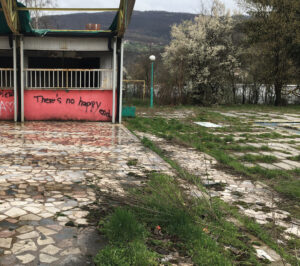
The Deadlock of Identity Politics
Today, the economic elite that emerged from postwar restructuring is linked closely with—or identical to—the political ruling class. Usually, its leaders are male, each of them with different ties to other strong men of global politics. While RS officials generally seek political alignment with autocrats of various geographies like Vladimir Putin, Aleksandar Vučić or Donald Trump, HDZ and SDA leaderships often cultivate closer relations with both member states and representatives of the European Union, but also with Turkey and Saudi Arabia.9 Whether it be the Croatian Democratic Union (HDZ BiH), the Bosniak Party of Democratic Action (SDA) or the Serbian Alliance of Independent Social Democrats (SNSD), all of these parties conceive of—and adjust their policies towards—their electorate in exclusively ethnic terms.
Despite efforts to weaken the hold of identity politics, Bosnia and Herzegovina’s political order remains captive to ethnonationalist parties. In part, because people continue voting for them. Why?10 First, because “ethnopolitics”11 is practiced in BiH through cultivating fear of other (ethnic) groups. This script is by no means exclusive to BiH, but integral to many nationalist and populist playbooks around the world. Still, BiH is distinctive. From a formerly unified language now presented as three languages (Bosnian, Croatian, Serbian), over the controversial “two schools under one roof” system and (mostly) divided labor unions, to the tripartite presidency: the Dayton-designed administration has formalized the ethnonationalist principle by separating key institutions “into three,” reinforcing political communities that constitute of each nationality’s “own” ethnic group.12 Second, doctors, teachers, civil servants and low-level public sector employees have been dependent on the support of the political structures in place and are politically vulnerable because authorities use threats of job loss and firing to quiet criticism and dissent. Additionally, political parties have manipulated the social benefits received by war veterans, pensioners and disabled people to control specific voter blocks.13
The Socio-Economic Conditions in BiH Today
These coercive tactics are effective, to some extent because many Bosnians still lack the basic conditions for socio-economic security. These have failed to develop, in part, due to rapid market liberalization and privatization. While such measures were intended to modernize the economy, they deepened unequal employment structures and significantly weakened the welfare system.14 Today, widespread unemployment, poverty risk, dysfunctional public infrastructure (especially in rural areas), and an inefficient social-protection system—including weak health insurance, welfare, maternity support, and lack of affordable childcare—leave many unable to access decent work or social services, or to participate freely in civic and economic life.15
It comes as no surprise that young people, in particular, whose lives have been shaped entirely by the postwar conditions, often seek a better future abroad. Emigration is most prevalent among the young, working-age population and the skilled labor force.16 An estimated one third or more of Bosnians now live outside BiH, a number best taken with a grain of salt, since BiH has not conducted a census since 2013 and other socio-economic indicators have proven unreliable.17 The remaining population is rapidly aging, placing additional strain on Bosnia and Herzegovina’s fragile health care and social systems, which suffer severe understaffing and chronic underfunding that has left the health care system among the weakest in Europe.18 In that sense, a life in dignity remains a potential rather than a reality.
Neither of those characteristics is unique to BiH; many countries in East and Southeast Europe share the socio-economic conditions as well as problems with nationalism and corruption accompanying the transition to capitalism.19 However, what is distinctive are the demobilizing and depoliticizing effects on society stemming from the dispersion of responsibility originating in the giant, tripartite state apparatus and the subsequent disillusionment with thirty years of democratization efforts.
Cui Bono? Dayton’s Legacy of International Involvement
International involvement has not resolved BiH’s structural contradictions; in many instances it has reproduced them. With the introduction of what were known as the “Bonn Powers” from 1997 onwards, it was especially the OHR that exercised powers usually associated with states, including imposing legislation and creating currency or passport systems. Between 2006 and 2014, its role was diminished for the sake of the EU accession process, envisioned as a potential for (democratic) reform. However, two recent uses of its power illustrate the OHR’s ambivalence. In July 2021, Valentin Inzko imposed amendments criminalizing the public denial or trivialization of genocide, crimes against humanity and war crimes—a step justified as a response to continuing denial of the Srebrenica genocide in 1995, including by RS president Milorad Dodik.20
By contrast, in 2023 the current HR Christian Schmidt, a German former CSU agricultural minister, reinterpreted aspects of contentious and unresolved existing property and land use law in ways that would have enabled the RS to grant temporary mining exploration concessions, notably for the highly sought-after resource lithium around Lopare. Because the RS is chronically bankrupt, the same leadership that had been subject of Inzko’s ruling is now heavily courting foreign investors—as well as Donald Trump22 —by offering access to RS-controlled natural resources. When the Bosnian constitutional court later declared the decision unlawful (after exploration in Lopare had already begun), Schmidt critically reported to the UN23 that this interpretation of law could have negative effects on development and investment, sidestepping local protests and environmental concerns.24
Such interventions often send contradictory signals but have direct consequences for the lives of Bosnian citizens. Even under the most benevolent interpretation, conferring final authority upon an unelected office is politically ambiguous. In its less benign form, that same concentration of power can mask external geopolitical and commercial interests, privileging investment and geopolitical stability over social justice and democratic participation. What is more, the institutionalized reproduction of ethnonationalist logics within the post-Dayton order continually regenerates the very “need” for an OHR endowed with autonomous authority to safeguard principles of democratic coexistence among the three constituent ethnicities—thereby perpetuating a fundamentally undemocratic feature of the post-Dayton system.
Conclusion
Despite all criticism, the DPA has managed to put an end to a long war and halt immediate suffering. That remains an achievement. Still, while the creation of group-specific protection and institutions may once have served a purpose, the constitution has not allowed sufficient room for Bosnia-Herzegovina to outgrow them. Instead, the current socio-economic conditions leave many to the risk of poverty, while the absence of socio-economic transitional justice and a persistent political stalemate expose a population scarred by war to recurring secessionist saber-rattling and the fear-mongering rhetoric of an opportunist elite.
Two lessons emerge. First, socio-economic questions cannot be treated as a technical matter of postwar reconstruction; they are inherently political and should be organized from below, with workers and communities, rather than above, with and through (international) institutions alone. Structural peace, hence the absence of social or institutional arrangements that systematically block people from meeting basic needs, demands an abandonment of elite-centered politics. Those within the European Union who today seek to negotiate peace elsewhere might begin by confronting similar dynamics among their own national elites—many of whom have recently quoted from the same fear-driven playbook Bosnian nationalists are reading. Second, future peace settlements—be they in Bosnia or elsewhere—should avoid cementing ethnic categories that often reinforce elitist structures which concentrate power and resources along ethnonational lines. Instead, peacebuilding should emerge from the material needs of those who live with their consequences.
 Download (pdf):
 To the list of references
Reihen
Ähnliche Beiträge
Schlagwörter

Latest posts by Christin Stühlen (see all)
- The Strait of Hormuz in Perspective: One Global Chokepoint, Multiple Vulnerabilities, Compounded Effects - 6. Mai 2026
- Thirty Years of Onion Politics: Bosnia and Herzegovina on the 30th anniversary of the Dayton Peace Agreement - 11. Dezember 2025
- Uprisings in Serbia. Struggle(s) against a resilient regime - 21. März 2025