


Resisting the Pushback: Worldwide Activism Against Femicide
The number of femicides is rising globally. Yet perpetrators often face reduced sentences, reflecting a societal normalization of violence against women. In recent weeks, feminist activists have mobilized to draw attention to the crisis as part of the UN-led annual campaign, “Orange the World.” Their activism highlights both the severity of femicides and the role of women and LGBTIQ+ communities as powerful agents of change. Yet effective prevention of femicide and gender-based violence requires solidarity from society and from political actors. All must work together to challenge the impunity of perpetrators, support survivors, and send strong signals that gender-based violence will not be tolerated.
Worldwide, the number of women killed by their partners is on the rise. Femicide, the murder of women because of their gender, is the highest form of violence against women and an acute form of gender-based violence. Globally, femicides have become a normalized part of society and perpetrators often get away with reduced sentences. In recent weeks, feminist activists around the world have staged protests drawing attention to the unprecedented proliferation of femicidal violence. Their activism is part of an annual UN-led campaign „Orange the World”, which aims to raise awareness about gender-based violence and particularly about femicide. This blog article joins the effort to raise awareness and aims to show that women and LGBTIQ+ communities are more than victims of violence: they are also powerful agents of change. However, we emphasize that when it comes to successfully preventing femicides what remains decisive is solidarity from all of society and for political actors to send powerful messages to potential perpetrators that impunity will not prevail.
The global rise in gender-based violence, including violence against LGTBTIQ+ communities, coincides with diverse forms of gender backlash that target women’s rights and gender equality. A clear example can be seen in the Trump Administration’s targeting of sexual and reproductive health rights through the closure of the USAID agency. Contraceptives worth 10 million Euro are currently awaiting their destruction in a warehouse in Belgium, all because the US government rejected offers from the UN and family planning organizations to buy or ship the supplies to nations in the Global South. This example is just the tip of the iceberg yet it indicates the scale of the current anti-gender backlash, with an increasing number of states actively supporting the restriction of women’s rights. Recently, Turkey and Latvia decided to leave the Istanbul Convention, a European Council treaty that aims to end violence against women. In the case of Latvia, feminist activists succeeded in resisting this pushback. While the Latvian Parliament voted in favor of leaving, president Edgars Rinkevics decided to postpone the decision until parliamentary elections next year.
The Continuum of Violence and how it Relates to Femicide
The broader anti-gender backlash coincides with the rise in gender-based violence and in particular with the rise in femicides, wherein people become victims solely on the basis of their gender. When looking at worldwide numbers of femicides, recent reports from the UN Office on Drugs and Crime and from UN Women find that femicides show no sign of slowing down on a global scale, despite the fact that both activism and political action world-wide have increased considerably over the last decade. Indeed, more than 50,000 women and girls were killed at the hands of intimate partners or family members in 2024 alone. In contrast, just 11 per cent of male homicides were perpetrated by intimate partners or family members during the same year.
Femicides do not occur in isolation; they reside at the one end of the continuum of violence. Feminists conceptualize violence as multi-faceted problem ranging from physical and domestic violence to forms of structural violence such as poverty and unemployment. Relations of inequality create conditions that make interpersonal violence more likely, normalized, and durable. At the other end of this continuum of violence are discursive forms of violence such as normalized sexist language, catcalling, or anti-gender language in social media. It is also important to note that femicides often begin with controlling behavior, threats, and harassment, including in social media. Digital violence does not remain online but escalates offline and can contribute to lethal harm, including femicides. A 2018 study showed that perpetrators of femicides first engaged in stalking their victims. Statistics also show that the risks faced by women worldwide can increase greatly depending on the country and region in which they live.
Femicides: The Case of South Africa
At 12 pm on 21 November 2025, at meeting points nationwide, South African women and LGBTQIA+ community members dressed in black and lay down on the ground for fifteen minutes as part of the G20 Women’s Shutdown, led by the Women for Change (WFC) South Africa non-profit organization. The campaign unfolded against the backdrop of South Africa’s unrelenting crisis of gender-based violence and femicide (GBVF), where a woman is murdered every 2.5 hours and the femicide rate is 6 times the global average. Placing the scourge of GBVF in South Africa squarely on the global governance agenda, the collective action coincided with the 10th anniversary of the W20, the G20 forum dedicated to gender equality and women’s empowerment. Participants were additionally encouraged to refrain from all paid and unpaid labor and to spend no money throughout the day – a deliberate, embodied demonstration of the social and economic weight of their absence.
Activism Against Femicides and its Limits
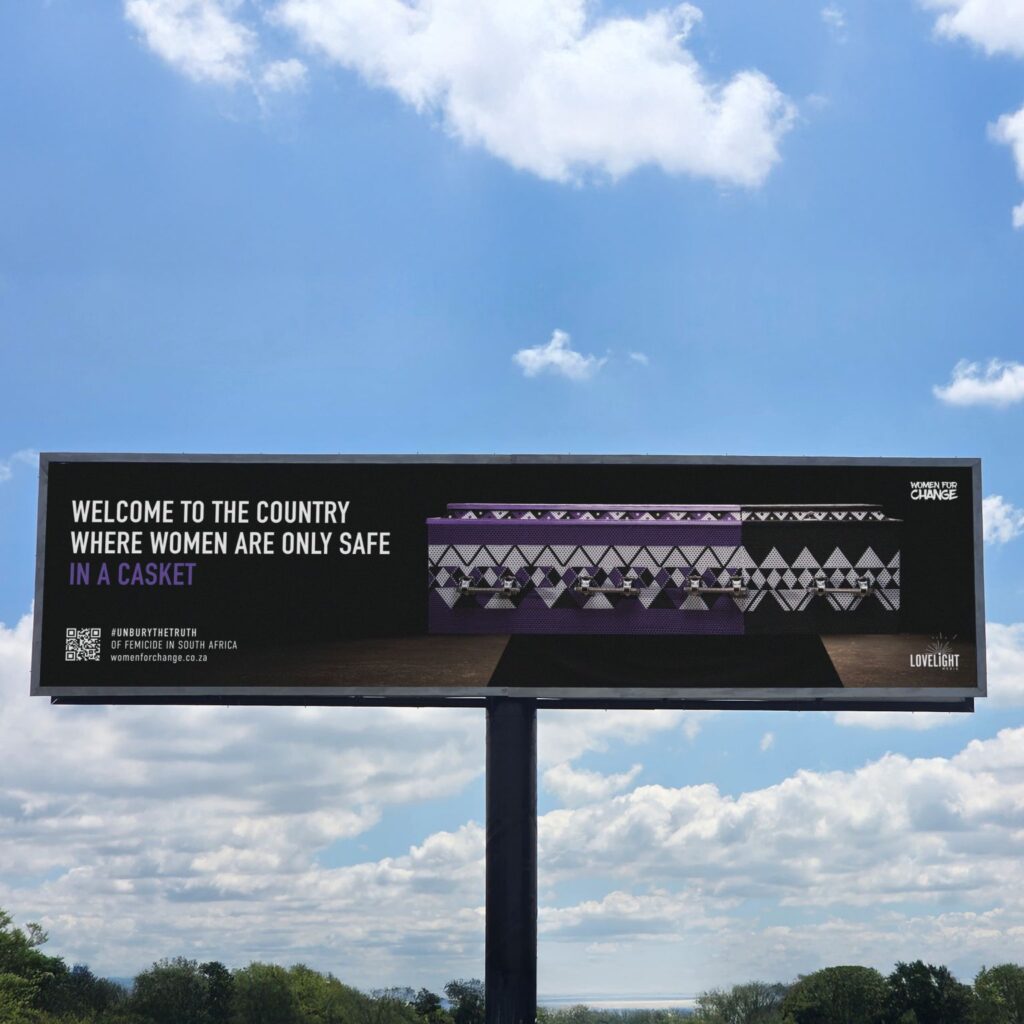
Women for Change South Africa, founded by the German feminist activist Sabrina Walter, is dedicated to fighting GBVF through grassroots mobilization, targeted policy demands, and embodied public action. A recent WFC campaign, the Unburied Casket, drew international acclaim for demonstrating how feminist resistance can transform grief into a form of truth that resonates far beyond South Africa. Participants in the campaign constructed a large coffin – scaled up by 33.8% compared to a standard casket – representing the discouraging rise in femicide between 2023 and 2024. The casket was then adorned with over 5000 traditional hand-crafted Zulu beads, each representing a victim of femicide, while portraits of victims lined the inside of the casket. In April 2025, activists carried the casket into government buildings in Pretoria, accompanied by a petition with over 150,000 signatures, demanding that Gender-Based Violence and Femicide be declared a National State of Disaster. An online version of the petition garnered more than 1 million signatures.
This act of feminist activism, amplified by mass participation, has become the catalyst for a major political turning point: the South African government’s decision to declare GBVF a national disaster. For the first time, the entire government must tackle GBVF as one coordinated force instead of disconnected departments. Mandatory reporting means accountability is no longer optional – progress will finally have to be proven.
Yet the GBVF crisis at South African universities highlights persistent institutional shortcomings. Policies on sexual violence and harassment are undermined when institutions disown responsibility for individual actions, normalizing these harms. University cases reflect a broader pattern of institutional betrayal, especially when police officers commit sexual violence against women being held in police custody, or when victims are attempting to report GBVF crimes. The LGBTQIA+ community in South Africa, particularly black lesbians and trans people, are subjected to the same GBVF through practices such as corrective rape, which occurs within a broader socio-cultural framework that stigmatizes victims and treats gendered bodies as sites of patriarchal control. The logic of patriarchy in South Africa, underpinned by religious teachings and tribal beliefs, fuels the crisis of GBVF while simultaneously working to bury the truth.
Data from the 2020/21 national femicide study reveal that in approximately 44 % of femicide cases, South African authorities failed to identify a perpetrator. This discouraging backdrop frames the harrowing case of Tshegofatso Pule, a victim of femicide who was identified after pictures and videos of her murder scene were circulated on social media by members of her local community. Her tragic death, and the systemic failures it exposed, echo the stark warning from President Cyril Ramaphosa that South Africa is one of “the most unsafe places in the world to be a woman.” Coming amidst the COVID-19 pandemic, the warning highlighted that the danger faced by women is not limited to individual cases but reflects a deeply entrenched societal and institutional crisis.
Femicides: Germany and Spain in Comparison
While South Africa may seem far away from the European Union, femicides remain an ongoing problem in European states. Two case studies serve to demonstrate the differences in state’s political action.
Every two days, in Germany, a woman dies at the hands of her partner, with a total of 334 women killed in 2024. This grim conclusion was reached by a new study carried out at the University of Tübingen. Crime statistics from the Federal Criminal Police Office also show that over 60 per cent of this domestic violence is perpetrated by German men. Recently, activists have drawn attention to the lack of violence prevention measures, pointing to cuts in social spending that have led to a shortage of places in women’s shelters. In November 2025, the German federal cabinet passed a new violence prevention law, which aims to introduce electronic ankle tags for potential perpetrators of violence. Yet critics of the measure have pointed out that such measures come too late and are isolated from more holistic prevention approaches to intimate-partner violence.
In Spain, by contrast, feminist activism has led to a much broader approach to the problem of femicide. Political actions have included the implementation of comprehensive legislation like the 2022 Organic Law on the Comprehensive Guarantee of Sexual Freedom, the creation of 24-hour assistance centers for sexual violence victims, and the establishment of the Joint Multiannual Plan on Violence against Women. The Spanish government also funds awareness campaigns, uses data to monitor problems, and operates a national helpline and integrated prevention system. The Group of Experts on Action against Violence against Women and Domestic Violence (GREVIO) has applauded the Spanish government’s progress in combatting violence against women and femicide.
Conclusion
While there has been growing awareness and public outcry against femicide, much more needs to be done to prevent violence against women and LGBTIQ+ communities. Above all, action must be taken to stop the current escalation, to provide adequate services to survivors, and to punish perpetrators. The examples in this blog article show how different countries and institutions can respond to femicide with action, complicity, or inertia. While valuable, actions like “Orange the World” cannot tackle the complexities of the problem alone. In many countries, the current global backlash against gender and feminism serves as legitimizing tool to stall political action and limit funding.
To combat and to prevent femicidal killing and gender-based violence, it is necessary to implement laws that recognize how violence can manifest throughout the lives of women, girls’, and LGBTIQ+ individuals, both online and offline. Above all, it is necessary to hold perpetrators to account long before their violence becomes deadly. While such immediate interventionism has to be perpetrator-focused to stop or prevent violence, further preventive action beyond law-making and implementation is needed. This could include measures like violence-prevention education trainings at schools, but also specialized training for police, judiciaries, and health workers. Responsible (social) media reporting on femicides that avoids victim-blaming and sensationalism while clearly naming femicides as incidents of gender-based violence can also be a crucial prevention tool that shapes public understanding, aids accountability, and contributes to political action.
Reihen
Ähnliche Beiträge
Schlagwörter

Latest posts by Simone Wisotzki (see all)
- The New US National Security Strategy: A Blog Analysis and Commentaries - 19. Dezember 2025
- Resisting the Pushback: Worldwide Activism Against Femicide - 17. Dezember 2025
- 25 Years of UNSCR 1325 on Women, Peace and Security (WPS): Birthday Party or Funeral? - 17. Juli 2025